
Concerning
I didn’t learn about institutional expectations from theory. I learned them in quiet, uneasy moments as an immigrant parent trying to understand my child’s school in the United States. In these moments, I realized there were rules no one had explained to me.
In the late 2010s, my husband was suddenly transferred by his workplace in Korea and we moved to New Jersey with our two sons. The decision came so abruptly that we had only a couple of months to prepare, which was not enough time to feel comfortable in English or learn the culture of a new country. I had been an elementary school teacher in Korea, but my sons and I had very limited English proficiency. We arrived feeling unprepared, and each day became a challenge. Outside our home, the world itself felt like a classroom filled with English and norms that we had to learn.
Determined to teach my children in any way I could, I went to the library, put my name on the waitlist of free adult ESL programs and even enrolled in a university-based ESL program. Each time the English I had learned in Korea felt useless, I felt a deep sense of helplessness. But I could not afford the luxury of dwelling on sadness.
One day, I got an email from my child’s teacher. The subject line of the email began with my child’s name, preceded by one word: concerning. I paused before opening the teacher’s email, feeling uneasy.
“Hello, Mrs. Lee. I would like to meet with you to discuss …”
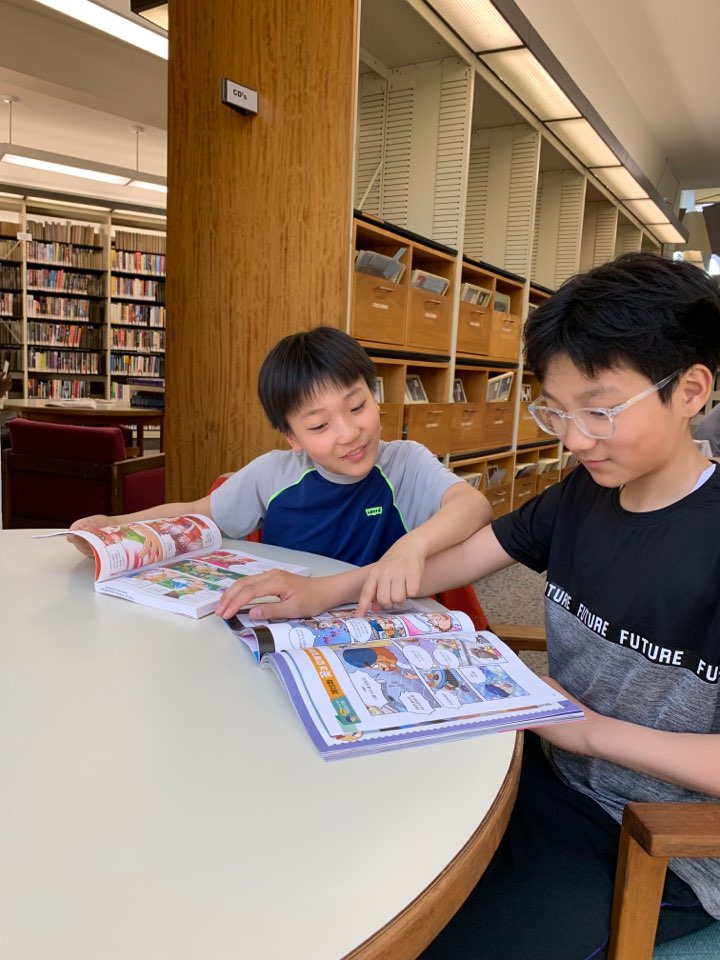
The author’s sons in the Englewood Public Library sitting at a round table reading Korean comic books. (Photo courtesy of the author)
Inner voice
Through my doctoral studies in elementary education, I came to recognize the long history of multicultural education in the United States. My growing interest in culturally relevant pedagogy offered a new lens for understanding my children’s experiences during their elementary school years. At the same time, my methodological interest in autoethnography drew me back to my own experiences and those of my family.

The author with her two children in front of a display of the Joseon Dynasty Korean gallery with mannequins dressed in hanbok. (Photo courtesy of the author)
Multilingual learners (MLs) need time not only to learn a new language but also to adjust to an entirely new cultural environment. During this period, teachers often perceive this process not as a transition but as a deficiency. Even when teachers include content about diverse cultures, races, or ethnic groups, they may still unintentionally transmit distortion or biases shaped by internalized white dominant norms (Delpit, 1995). This may occur because educators have not had sufficient opportunities to study the histories and cultures of communities to which they do not belong (Sleeter, 2001).
In this context, immigrant families who have limited cultural capital with the U.S. school system face additional challenges. These conditions can produce a sense of deficiency and a desire to align with mainstream norms. Students’ hesitation may be read as a lack of academic ability or as poor performance (Cummins, 2000). Standardized curricula and assessments often assume uniform background knowledge and teachers may equate fluent verbal expression with active participation. Over time, these assumptions position MLs as academically behind, less capable or unable to catch up.
Once MLs begin to internalize these messages, projecting the dominant discourses onto themselves, it becomes difficult to escape them. This internalization can shape an inner voice that contributes to anxiety, feelings of inferiority and sometimes depression (McIntyre et al., 2018). Immigrant parents may experience similar anxieties when navigating unfamiliar school expectations, particularly if their cultural background does not align with dominant norms (Song et al., 2022).
Cultural inheritance
As an international student in the U.S., I realized that my own cultural differences can serve as a lens through which I interpret educational experiences. These varied perspectives shape new insights and offer deeper understanding or fresh approaches to challenges.
According to Kyung-Sup Chang (2010), South Korean society is characterized by a plurality of values and institutions, particularly visible in family ideologies that simultaneously carry traditional norms and absorb Western cultural influence.
The development of modern South Korea involved the adoption of American-style political, social and economic systems, with particularly strong influence on education. Within this context, educational credentials became an important route to social mobility. Consequently, qualification-based programs increased the perceived value of educational investment and intensified academic competition (Chang, 2010).
As this competition intensified, access to educational resources and knowledge about shifting policies became increasingly important. In this context, a social expectation emerged that mothers, who are often more involved in daily childrearing than fathers and are traditionally positioned as breadwinners, would take primary responsibility for managing their children’s education (Landeros, 2011; Lee et al., 2025).
As a result, both the credit for children’s educational success and the responsibility for their failure have been largely attributed to mothers. This expectation reflects broader social constructions of mothers as primary caregivers and positions caregiving as a means of securing children’s competitive advantage (Landeros, 2011). In addition, elementary education, which involves significant emotional labor, has historically been associated with women’s work. These dynamics have been further reinforced by enduring cultural and historical ideals of motherhood (Grumet, 1988). In collectivist contexts such as Korea, mothers may also come to equate their own success with that of their children, a phenomenon often reflected in labels such as “tiger mom” (Zhang et al., 2023) and “helicopter mom” (Lee et al., 2025). These cultural expectations did not disappear after migration; rather, they intersected with new institutional expectations in the U.S. school system.
Revisiting the unresolved knot
Unstated expectations often make parents from groups with uneven cultural capital feel anxious and intensify their fear that their children may not succeed. This dynamic has also been identified in research on immigrant education. For example, Angela Valenzuela (1999) describes how “subtractive schooling” devalues students’ linguistic and cultural resources, while Bic Ngo (2024) shows how schooling can produce cultural erasure that marginalizes immigrant identities.
Several years later, these theoretical perspectives provided a foundation for examining the U.S. education system through a broader lens. Understanding of schools, teachers and education gradually shifted.
What once felt confusing and personal now appeared as part of a larger structure. Still, the unresolved knot from my earlier experiences remained, quietly shaping how I understood education and belonging. When I look back, I sometimes imagine meeting my past self. I wonder what I would say to her and what might have been different if she had understood the system as I do now.
What I inherited
As I reflect on my experiences navigating the U.S. school system as an immigrant parent, I now recognize how a lack of cultural capital shaped my understanding and interactions. Immigrant families who lack familiarity with the expectations of the U.S. school system often face additional challenges which can create feelings of deficiency and a strong desire to conform to mainstream norms.
In my case, I often felt that I needed to prove myself as a “good” parent within an unfamiliar system. At the same time, the dominant discourse within schools often emphasizes student academic achievement and parental commitment. When these expectations are met, immigrant families often receive conditional acceptance; however, this inclusion is often precarious. Their position within the school community frequently remains at the margins rather than at the center.
Understanding these power dynamics allows for a clearer comprehension of the anxiety I once felt as a parent striving to find my place within the school system (Zhou & Kim, 2006). It also highlights how individuals may be seen differently depending on where they stand and who is looking at them, and how these external frames can gradually shape one’s sense of self. This reflection reminds me that teachers, often without realizing it, play a powerful role in framing how students are seen and understood.
Like a frog struggling in milk, I kept moving, doing what I believed I could do. I pushed forward, passed the exams to advance to the upper-level classes of private academics, met the required score on the TOEFL and then reached a strong GRE score, eventually entering graduate school. During this struggle, I recognized these dynamics underscores the importance of educational approaches that critically attend to identity, power and inclusion. By continuing to examine these institutional dynamics, we can work toward a future where diverse families feel truly included and valued, and where educational equity is not conditional but foundational.
References
Chang, K. (2010). South Korea under compressed modernity : familial political economy in transition. Routledge.
Cummins, J. (2000). Putting Language Proficiency. English in Europe: The acquisition of a third language, 19, 54.
Delpit, L. (1995). Other People’s Children: Cultural Conflict in the Classroom.
W. Grumet, M. R. (1988). Bitter milk: Women and teaching. In Bitter Milk. University of Massachusetts Press.
Landeros, M. (2011). Defining the ‘good mother’and the ‘professional teacher’: Parent–teacher relationships in an affluent school district. Gender and Education, 23(3), 247-262.
Lee, C. R., Wu, Q., Park, S. P., Marroquin, C. G., Jalapa, K., Han, S., & Tawfiq, D. (2025). Understanding Korean parents’ expectations and parenting: A sex perspective. Journal of Applied Developmental Psychology, 101, Article 101885. https://doi.org/10.1016/j.appdev.2025.101885
McIntyre, R., Smith, P., & Rimes, K. A. (2018). The role of self-criticism in common mental health difficulties in students: A systematic review of prospective studies. Mental Health & Prevention, 10, 13-27.
NGO, B. (2024). Re-membering Culture: Erasure and Renewal in Hmong American Education. University of Minnesota Press. http://www.jstor.org/stable/10.5749/jj.14086468.
Sleeter, C. E. (2001). Preparing Teachers for Culturally Diverse Schools: Research and the Overwhelming Presence of Whiteness. Journal of Teacher Education, 52(2), 94–106. https://doi.org/10.1177/0022487101052002002
Song, J. E., Roh, E. H., Kim, Y. J., & Ahn, J. A. (2022). Effects of maternal adjustment enhancement Program using mobile-based education for Chinese immigrant women in Korea: A quasi-experimental study. Journal of Transcultural Nursing, 33(6), 685-694.
Zhang, M.-R., Shen, Y., Choi, Y., & Kim, K. (2023). Parental Academic Socialization and Youth Adjustments: A Comparison of Korean Youth in South Korea, China, and the United States. Journal of Youth and Adolescence, 52(12), 2526–2544. https://doi.org/10.1007/s10964-023-01845-z
Zhou, M., & Kim, S. S. (2006). Community forces, social capital, and educational achievement: The case of supplementary education in the Chinese and Korean immigrant communities. Harvard Educational Review, 76(1), 1–29. https://doi.org/10.17763/haer.76.1.u08t548554882477