
“Remembering and getting a good education,” as my mom and my dad believed and always insisted, was the only way to imagine and dream for a better future for Black people in the United States—a country, at its “founding” core, steeped in a history of theft of land and Black bodies, brutality and violence against them and death and desecration of those lands and Black bodies. Most important to my parents was their belief that access to a better education would create a pathway to increased opportunities for me, which they believed would increase my chances for upward mobility. Foundational to this educational imagining and dreaming has always been the collective memory of Black history, especially the resistance and refusal in service to a better education.
My parents were two of the thousands of Black Southerners who refused the “slave wages” of the south and migrated to Detroit, Michigan to work at one of the Henry Ford Motor Company factories. At the time, it was the first major automobile company to hire Black workers and to commit to paying them the same rate—$5 dollars a day—that it paid white workers with the same level of skill and experience doing the same job. My parents, like so many others, were in search of the promise of a Black middle-class lifestyle, which included, of course, an automobile, a home, and an education for their children. In order to obtain these prized possessions, my parents believed a “better” education was the only way. Their idea of an education was not just formal, but informal. The informal education, the hidden Black curriculum, was often shared through stories of Black histories across the African diaspora during meals and car rides as examples of insistence and persistence. They wanted me to carry this as a source of foundational support for my formal education.
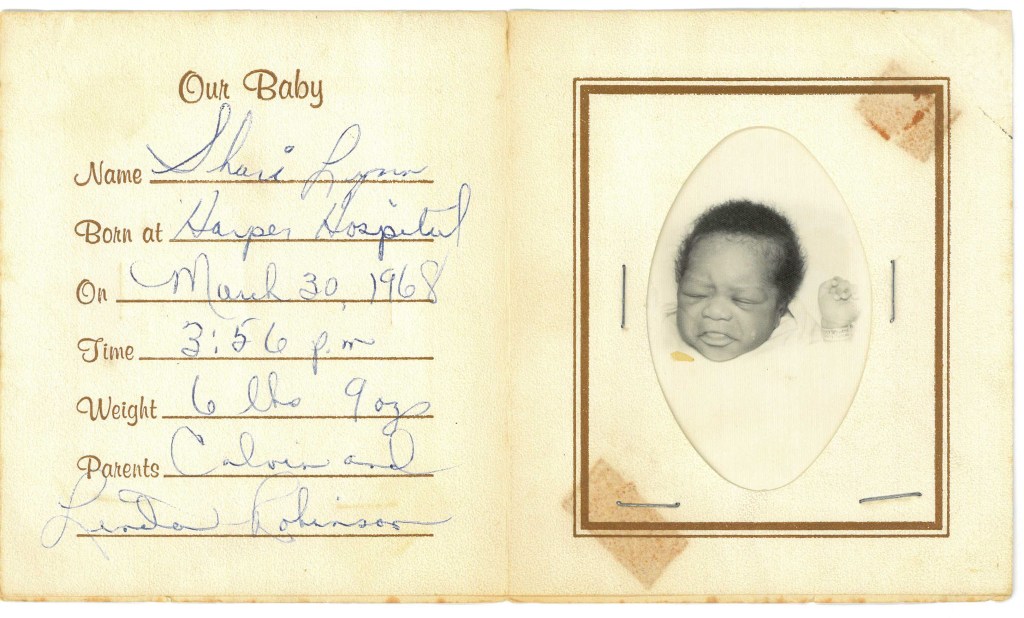
Birth announcement of the author, Shari Lynn Robinson. Photo credit: Harper Hospital, Detroit, MI. (Personal photograph, 1968)
The Detroit Uprising
My parents’ lives, like other Black families in Detroit, were deeply impacted by the anti-Black racism and militarized violence against Black communities that surfaced during the Detroit Uprising. During the early morning hours on Sunday, July 23, 1967, an unnamed “blind pig,” a popular late night bar that catered to Black clubgoers who were not permitted to enter other whites-only establishments, was raided by the Detroit Police Department. The raid was yet another example of ongoing police harassment and violence in Detroit. The response was also known as the Long, Hot Summer of 1967—the city smoldered and sweated through more than 10 days of nearly 100-degree heat and sticky humidity during the months of April-August. Home air-conditioning units were an expensive luxury back then. There were similar uprisings across dozens of other major urban cities and areas where the population consisted of mostly Black people, including north Minneapolis. Then-Michigan Governor George Romney sent in thousands of National Guard Troops, and U.S. President Lyndon B. Johnson deployed the U.S. Army troops on the ground and in the air equipped with tanks and a sickening arsenal of deadly weapons, including military-grade firearms and bayonets. There were hundreds of beatings and deaths in Detroit that summer, mostly at the hands of the Detroit Police Department, state troopers, the National Guard, and the U.S. Army. During that time, my mom was inside the house in the very early months of her pregnancy, fearfully watching tanks filled with fatigue-wearing, rifle-carrying white men. I believe I soaked in some of my mother’s resistance and refusal during my months of gestation in her womb.
My parents, like so many others, were in search of the promise of a Black middle-class lifestyle which included, of course, an automobile, a home, and an education for their children.
I was born in Detroit, Michigan on March 30, 1968, nine months after the beginning of the Detroit Uprising, three years after the assassination of Minister el-Hajj Malik el-Shabazz, widely known as Malcolm X, four days before the assassination of the Dr./Rev. Martin Luther King, Jr. and two months after the sudden death of my maternal grand-dad. Of course, I do not remember any of this, but I am certain I swallowed some of my mom’s enormous grief following the sudden death of her father. Growing up, I was repeatedly and lovingly reminded by my mom and dad of the extraordinary lives, legacies, and sudden deaths of these three important Black men. Inheriting these powerful, grief-laden stories and memories from my parents had a profound impact on my childhood experiences.
Many of my childhood weekends were spent learning parts of the hidden Black curriculum which was rooted in the religious and political followings of my parents. My mom’s involvement in a local Southern Baptist church included Sunday lessons from the Bible about the stories of resistance and refusal of our enslaved African ancestors, framed through their adapted and accepted teachings about the eternal love and acceptance of Jesus Christ. I was baptized at a very early age and I remember being asked by my visiting grandparents to lead the family in grace before dinner. It was all so confusing, but some of the Christian tenants still remain. While I do not remember any specific lessons, I do know that Christianity, in general, teaches that Jesus Christ extended, and continues to extend grace. I believe this is, in part, why one of my favorite words to this day is grace.

Nation of Islam Flag. (Photo by Oren neu dag, CC BY 2.0, Wikipedia)

Crucifix. (Photo by Aaron Burden, Unsplash)
While my mom’s religious practices followed the teachings of a man born in Palestine who is often white-washed as a blond, blue eyed, white man, my father’s religious practices and political affiliations featured undeniable Black men. On occasions, my mom and I would don the abaya, a long, loose fitting robe-like garment, and/or the hijab to join him at the Nation of Islam (NOI) Masjid (Mosque) No. 1. I only have a few memories of my time in that temple, but over the years I learned it was the location where the movement was founded and where the first masjid was established for the NOI in 1930. I remember my dad teaching me stories of resistance and refusal on matters of importance related to Black history and Black politics, as well as the Black Panther movement during teachings from the Qur’an. I do not remember any specifics, but I do recall the feelings. Some of my feelings are situated in anger, fear and mistrust of white people, which I have since learned to extrapolate to the deeply harmful and historical system of whiteness. Some of them are feelings of confusion about my sexuality which was repeatedly demonized. Despite that, I also remember feeling so much Black love—my father purchasing bags of ready to eat fresh fruit and and reading The Final Call (NOI newsletter) at stop lights on the streets of Detroit—my mom’s navy bean pies, staples at most NOI community events—so much delicious food rooted in Black love and Black history. From my mom, I learned patience; from my dad, I learned persistence. Sharing the concepts of grace and love in the university classroom is just one way I continue to honor and appreciate them.
The safety and security of Blackness in formal education spaces
Combined with my parents’ informal religious and political education was an equally important formal education which was rooted in the safety of Blackness. My elementary educational journey was at a private school for inner-city, middle-class Black children founded by a Black man who was a former Detroit Public School Board administrator. From first grade until fifth grade, I had the same Black woman teacher who taught all our academic subjects in the same classroom. I kept in touch with her for many years until her death—in the late 1990s when I went back to work after giving birth to my daughter, she would become my daughter’s first preschool teacher. I have fond elementary school memories of being surrounded by all Black administrators, staff, teachers and fellow students. The highlight of these memories was our school’s annual graduation ceremony where Black excellence was on display as our achievements and honors were recognized with accolades, certificates and trophies. When it was time to leave the safe haven of these Black spaces to attend a public middle school, I carried all those important memories with me.
The predominantly, though not exclusively, Black public middle school I attended was within walking distance of our home. My memories are fractured during this time, but I clearly remember my dad coming to the school to insist on his refusal on many things public schools required at that time: hearing tests, eye tests, teeth examinations and cleanings, as well as the popular and damaging personality and career aptitude tests of the 1970s and 1980s. While at the time I felt deeply embarrassed, it was a very important lesson—not only refusal, but what I now know to be the historic and systemic ways in which Black children were, and still are, misdiagnosed and misdirected in educational settings.
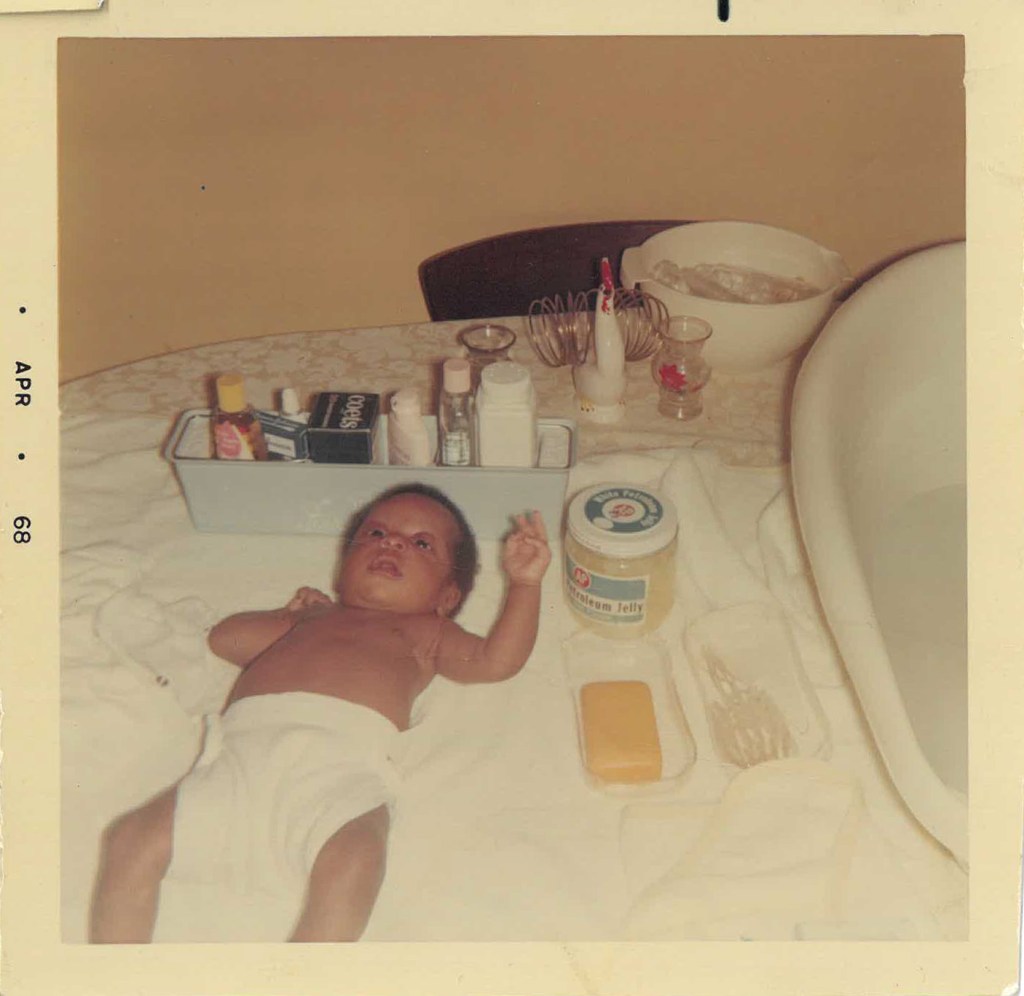
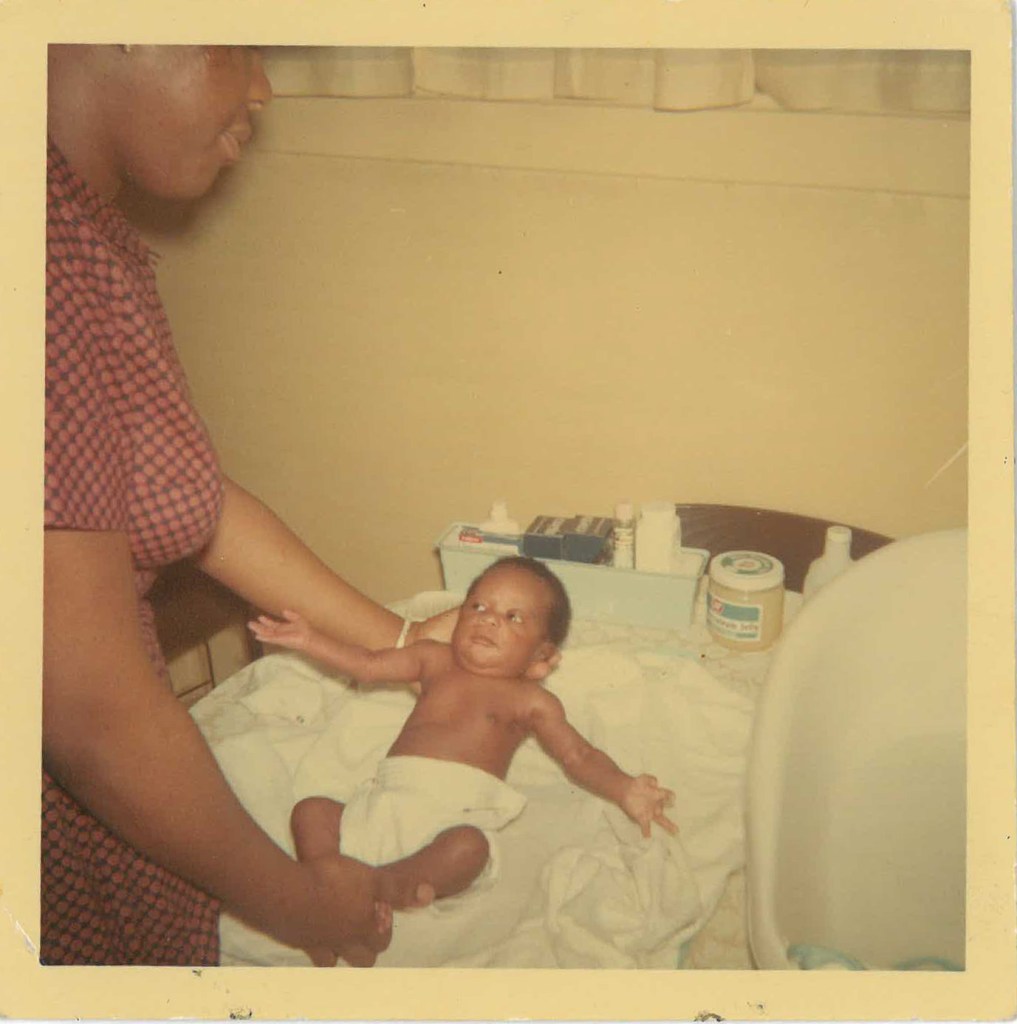

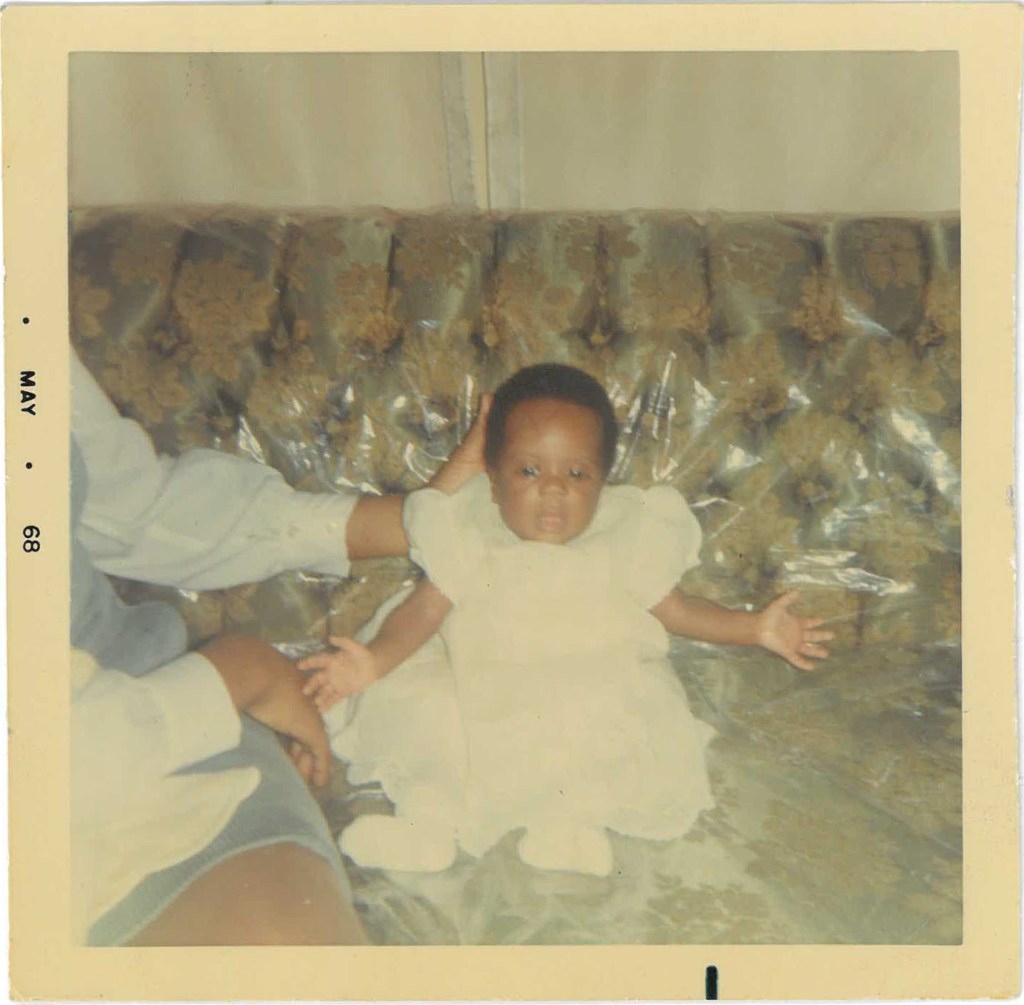

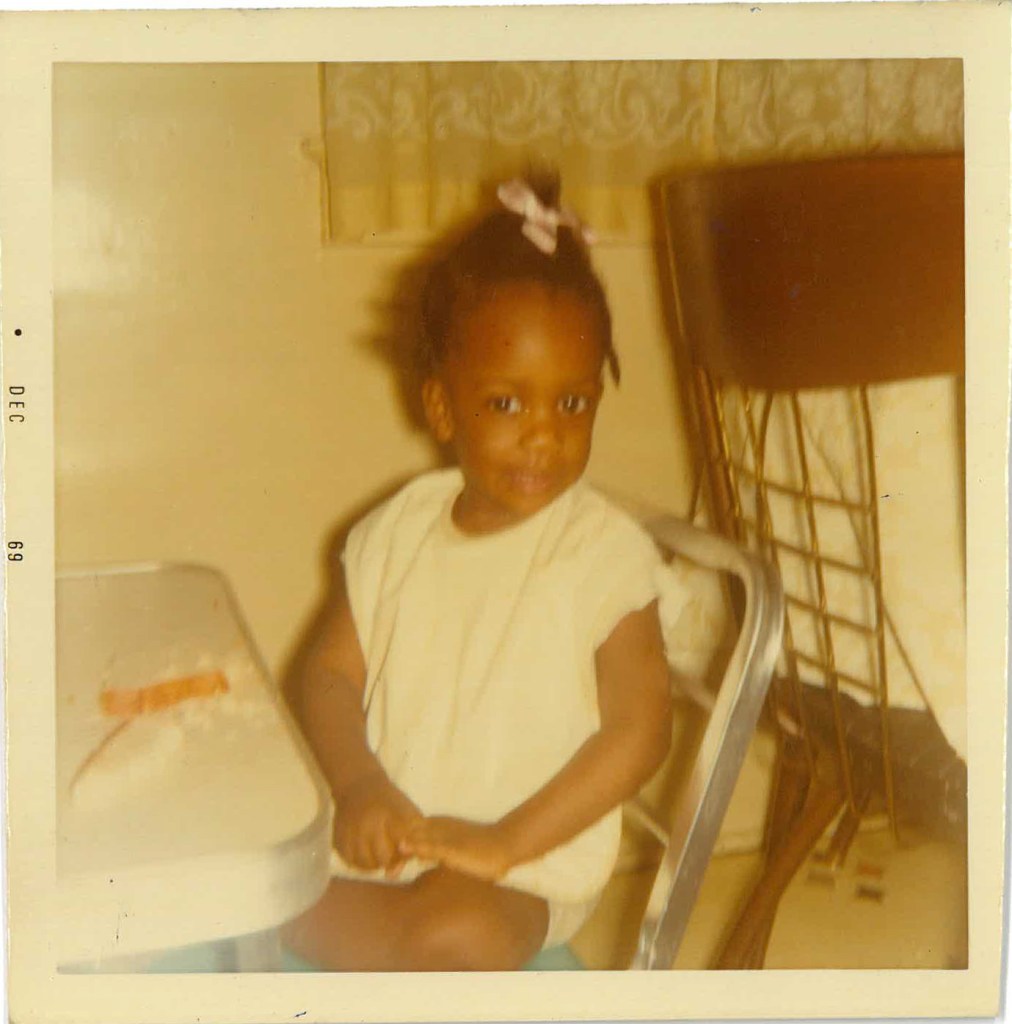

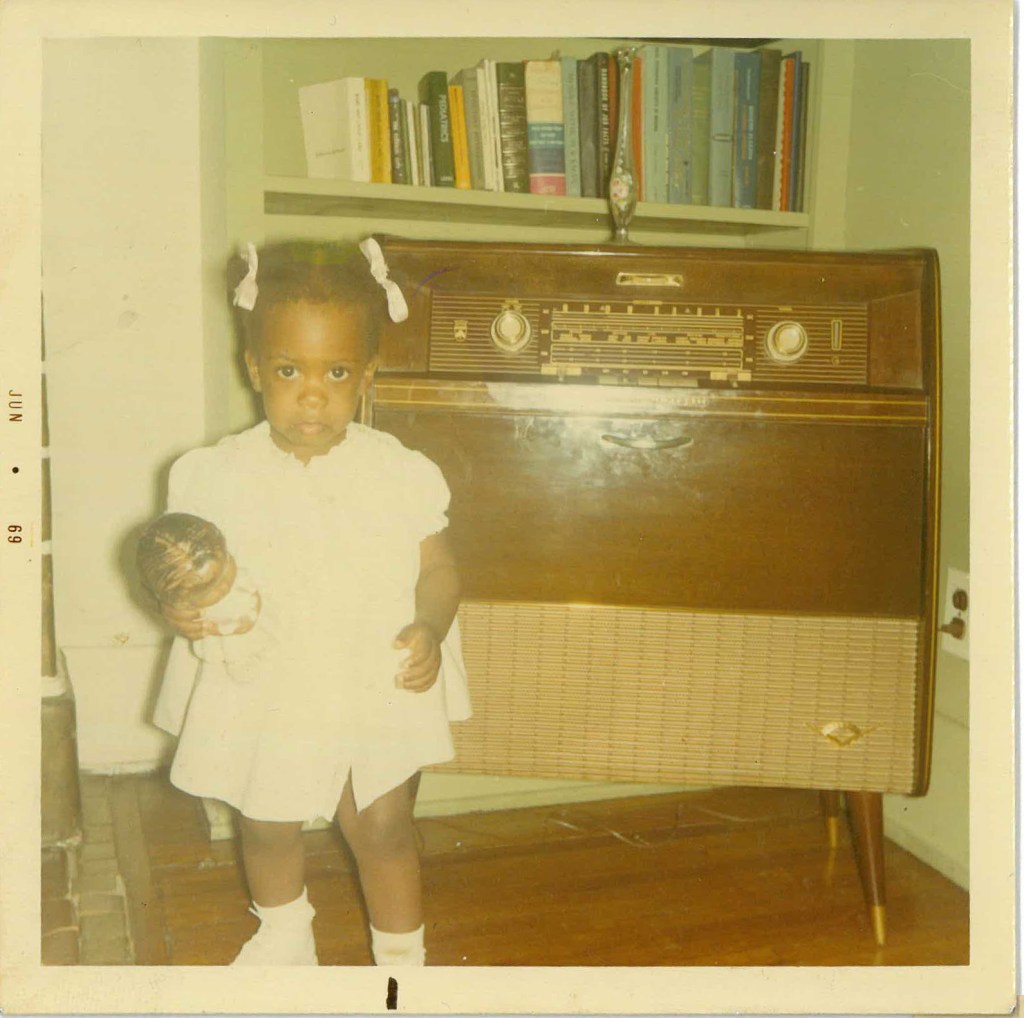
Clockwise from top left: Baby Shari and her mother during a diaper change (Photo by author’s father, personal photograph, 1968); Baby Shari laying down with care products for diaper change (Photo by author’s father, personal photograph, 1968); Baby Shari on the family couch (Photo by author’s father, personal photograph, 1968); Toddler Shari at home sitting at the table (Photo by author’s father, personal photograph, 1969); Toddler Shari with her favorite baby doll in front of the record player radio (Photo by author’s father, personal photograph, 1969); Toddler Shari standing up in her crib (Photo by author’s father, personal photograph, 1969); Baby Shari in a stroller (Photo by author’s father, personal photograph, 1968); Baby Shari getting a bath (Photo by author’s father, personal photograph, 1968).
During my middle school years I learned to be independent, but quietly cautious of white women. I have pleasant memories of walking home from school because I often spent my four dimes in bus fare on packs of Now and Later candy instead of using the money to catch the bus. I was among the many original “Latchkey Kids.” I think the sugar kept me alert enough to complete my homework while waiting for my mom to come home and cook dinner. During that time, I was also frequently at the nearby public library where I treated the white women librarians as my de facto mothers. They were not always kind or respectful, but always watchful and encouraged my love for reading, especially all the encyclopedias, while also helping me understand the card catalog and the Dewey Decimal system. I am sure these library experiences deepened my love for books, not electronic-books, which I hold today. I was among dozens of Black students who were kept physically safe as we waited for our parents to pick us up. On the car rides home with my mom, she often tried to explain the tenuous and unspoken relationship she had with those white women librarians whom I was told to respect but to not trust. These complicated racial tensions remain a personal and professional challenge for me.

Library card catalogue. (Image by Wikimedia Commons contributors, NOAA Central Library Card Catalog 1, Wikimedia Commons)
Learning to hide: Navigating intersectional identities

(Image Source: Flickr)
I attended one of the only two test admitting, public, college-preparatory high schools in Detroit at the time, and I have a mixture of both good and not-so-good memories. First, as much as I believed that my parents’ interracial high school experiences were supposed to help me build the skills necessary to, in my mother’s words, “Deal with white people,” it was mostly difficult. There was a visible racial divide which also played out across income and class differences with the “well to do” white and Black students hanging out together. I found my friends in the shadows of smart Black students who “acted out” by being “Prince super fans.” The movie “Purple Rain” came out in 1984 when I was a sophomore—of course, I went to see it! It remains one of a very few dishonest things I did in high school that my mom and dad, supposedly, never knew about. We wore purple leg warmers and bandanas, black studded double belts and pastel colored jelly jackets. I also did not know how to navigate the class-divide among the Black students. I remember being teased a lot for not wearing the latest preppy attire—pastel colored Izod and Ralph Lauren polos, Guess and Gloria Vanderbilt jeans, and spotless, white leather Reebok gym shoes. I have always believed my mom and dad were able to purchase those things, but they did not. They never gave me a reason. My father would simply insist that I would not be wearing “some white [wo]man’s clothing on my body.” I suppose it is why, even today, if there is a designer’s name, famous or not, on a piece of clothing, I will not wear it.
While I often struggled navigating racial and class differences in high school, the most impactful memories I have were being exposed, for the first time ever, to (white) gay men and (white) lesbians. It was through quietly observing and admiring them that I learned the dangerous yet safe art of hiding. My high school madrigals choir director and his accompanying pianist were two white gay men rumored to be a couple. I did not know for certain that they were a couple until I heard that the pianist died from complications of AIDS years later while working at one of my first jobs as a hospice social worker. I was able to attend a community remembrance event and spoke directly with the director. Likewise, my favorite high school teacher in my Advanced Placement English class was a white woman whose rumored partner was my physical education teacher, a Black woman. Observing them arrive in separate cars to our senior picnic and then spend time with us trying their best to not look like a couple is another memory that has been difficult to classify. High school is already often challenging. The class wars, my difficulty with navigating racial differences, and the cultural invisibility of two of my favorite teachers, which reinforced my decision to remain invisible as well, made it that much worse.
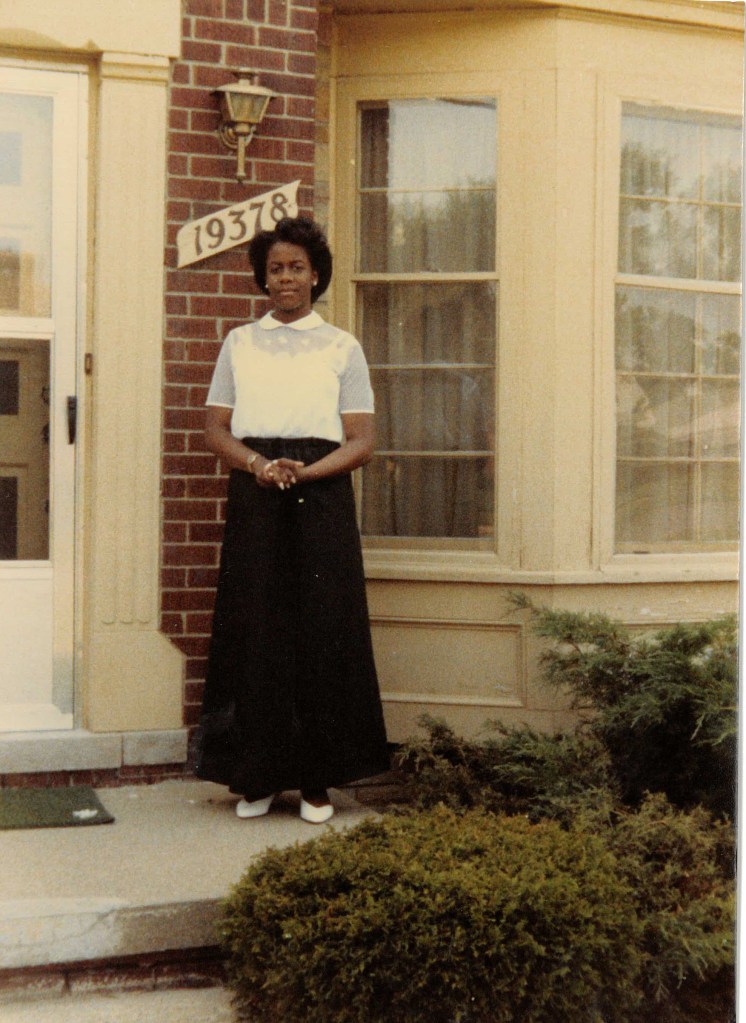
High school Shari standing on her front step of home in Detroit, MI in choir outfit. (Photo by unknown, personal photograph, 1984)
Three of my most salient identities are that I am a Black woman who is also queer. My identity as a Black person was always affirmed and embraced by my parents. My identity as a woman, much less so. I continue to process and reflect on my complicated memories about womanhood, as observed through my mom, as well as my dad. My queerness, which is contextually not always visible, has never been embraced by either of my parents. At nearly 60 years old, I doubt it ever will be. As a part of my ongoing healing around this invisibility, I come out whenever I can—not for acceptance, but as an act of the very refusal and resistance my parents taught me. Also, no matter the subject I teach, I always come out in class. Inevitably, there are students who share in my evaluations that they did not care to know and wish I would have kept this “private” thing to myself. However, there are also students, often students of color, who thank me for it and then feel safer doing so. I will keep doing it for those students.
Between HBCU and PWSIs
I suspect that when it came time for me to graduate from high school in 1986 and leave from “under his roof,” my dad continued to want me to be safe amongst other Black people while also experiencing spaces of Black shared knowledge production. So, when it came time for me to go to college, my dad announced that I had to attend a Historically Black College and University (HBCU) in order for him to pay my tuition—and I accepted his offer. I arrived at Alabama A&M University in Huntsville, Alabama in the summer of 1986 full of excitement. It was the first one listed on my guidance counselors list and it was also far away from Detroit. Once in Alabama, I remember looking for courses which I thought would prepare me for my lifelong dream of world travel as the first Black woman anthropologist for National Geographic. There were none, so I chose a career my advisor said was “good” for young Black women—a helping profession. However, psychology felt too cerebral and it was not the right fit for me. When I went back to my advisor, she suggested social work as a “desirable” and “financially stable” career choice, along with teaching and nursing, for young Black college women at the time. Social work felt like the right fit for me and so I decided to transfer to another institution once the social work program lost its accreditation. The Black curriculum was not hidden at Alabama A&M University—it was out, loud and proud. It was one of my first opportunities to experience the safety and security of Blackness outside of the safety of my home spaces and my parents. Although I left A & M, all was not lost. Highlighted memories include being on the charter line for the Divine Nine Black sorority, Sigma Gamma Rho, Kappa Iota chapter. It was the perfect combination of a familiar pro-Black space and the previously side-lined affirmations of Black womanhood that I did not know I needed. I enjoyed those experiences while still hiding and unable to confirm to myself, but, finally privately exploring my sexuality.

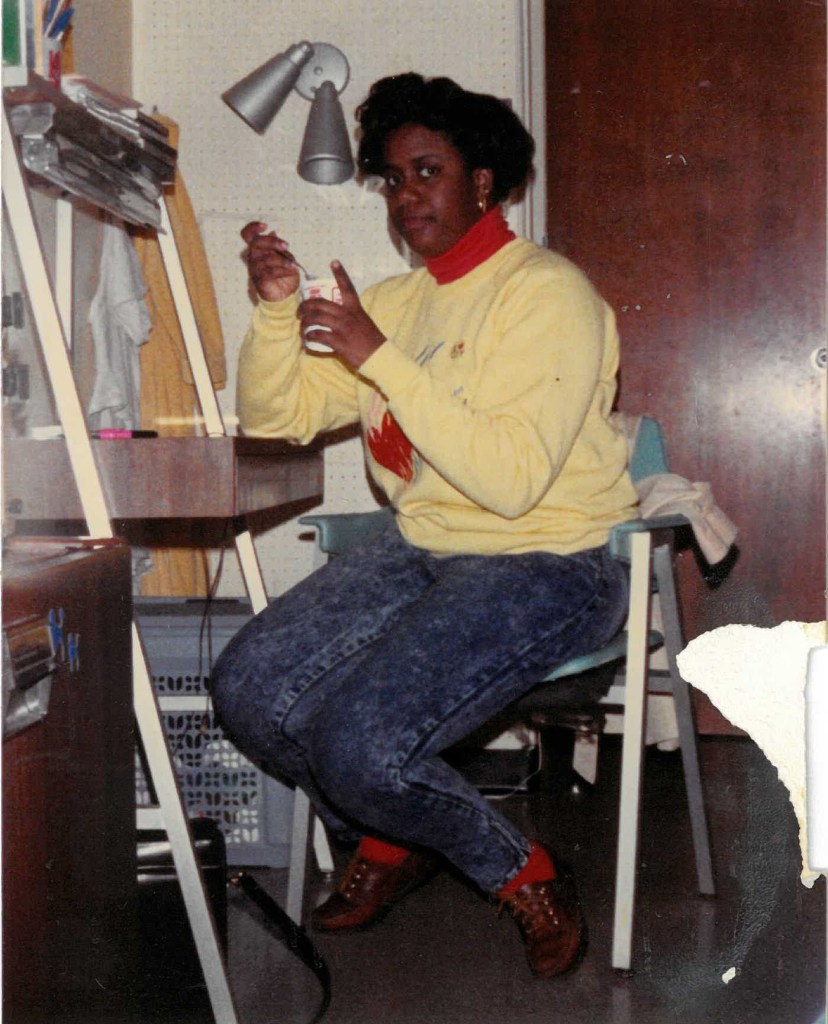
Left: Shari posing with high school diploma following high school graduation, posing in front of the “wall of achievements.” (Photo by unknown, personal photograph, 1986). Right: College Shari sitting at her dorm room desk at Alabama A & M. (Photo by author’s college roommate, personal photograph, 1986)
I transferred to the University of Alabama, a predominantly white-serving institution (PWSI), in 1988. One of my most memorable experiences is having the white parents of my first white roommate insist that she not be required to be my roommate. This was fodder for my dad. It was an example for him to reinforce his teachings about racism. My roommate’s parents lost the fight. “Just watch out!” my dad told me. We found our rhythm. Later, I introduced my room-mate to smelly yet delicious collard greens and she introduced me to white country music artists. While I continue to appreciate the poetry of some country music, I do not know if she still enjoys collard greens. We kept in touch for several years after we graduated, but soon lost touch. I have often shared this memory when teaching as a case study for dialogue about the challenges of these types of informal yet forced cross-racial learning opportunities. I also have painful memories of white, mostly male professors asking me, “Why are you here?” marking me down on papers without explanation, ignoring my raised hand and then telling me to, “Stop showing off,” when they did call on me to answer their questions. In those moments, and others, I remember feeling invisible while simultaneously not being able to hide. I was only soothed by the Black histories, Black memories, and Black lessons of my parents. I graduated with my bachelor’s degree in social work in 1990 from the University of Alabama and could not wait to return to the safe haven of Blackness.
I have painful memories of white, mostly male, professors asking me, “Why are you here?”
I moved back to Michigan for my post-graduation experience and to support my mom in her efforts of taking care of her mom who had multiple health issues and was later diagnosed with dementia. It felt so good to be home and to be reminded of the stories of Black refusals and resistance of my parents while growing closer to my grandma. My grandma’s diagnosis and my time supporting my mom’s efforts to take care of her outside of a nursing facility were the inspiration behind me attending graduate school and my chosen course of study. I chose to attend a predominately Black, state run university in the heart of the city of Detroit. It felt like a good choice. I graduated with my master’s degree in social work in 1993 with a concentration and certificate in gerontology. I returned a few years later after the birth of my daughter, for my first attempt at earning a Ph.D. I was in my program for two and half years before realizing it was too difficult for me to juggle doctoral course work, new motherhood responsibilities, ongoing internal struggles with my sexuality, and an unsupportive and sexually harassing advisor. After experiencing my first travel outside the U.S. to Belize, where I conducted my pre-dissertation research, I chose to complete my remaining three courses and instead earn a second master’s degree in linguistic anthropology. Unfortunately, after submitting my thesis and application for graduation, I was denied approval for graduation after filing a complaint against my former advisor. I carried that unresolved anger until my former advisor’s death in 2023. Carrying my earned course credits but not a formal second master’s degree, along with my still fresh memories of discouragement, disappointment, and a budding disillusionment with the academy, I put aside post-graduate education for many years to focus on family, my social work career and my budding social work teaching.
Travel lessons: Personal and professional risks and making refusals
I carried all those Michigan stories and memories of resistance and refusal—from my enslaved Black African ancestors, my Black mom and dad, examples of national Black excellence, my mostly affirming Black African-centric educational experiences, Black teachings from the Black Southern Baptists, the Nation of Islam, Black Pan Africanisms, the Black Panther movement, to my own “higher” education experiences—into every social work and anthropology classroom I taught at colleges and universities throughout Michigan,but it would soon be time to leave.
Traveling is one of the ways I dream and imagine. As I approached turning 50 and my daughter approached the all-important life milestone of 21, I took advantage of a professional opportunity to leave Michigan. In 2016, I traveled to Massachusetts where I enjoyed my first full time clinical professorship. I also had my second Ph.D. experience. When my three-year contract ended in 2019, I was offered the all-too-common, inequitable administrator-teaching combo position and I refused it. It remains one of my proudest moments of resistance in the academy. It was a risky decision which resulted in a significant gap in work experience on my CV. I have often shared this experience as a consequence of the privilege of choice. I spent all of my accrued savings, along with quite a bit of my newly established retirement fund. Then, about six months later, I was offered a position as a full-time administrator at another university. In March 2020, I was encouraged to “quietly leave” that institution after some extensive personal issues that happened at the same time with being one of the first unfortunate people to suffer from ongoing symptoms of what later was identified as COVID-19. After the harrowing experience of contracting COVID-19, I learned that resistance and refusal were not only viable survival responses in academia, but also in my personal life as well.
While I have never found traveling scary, it has sometimes felt risky, although fear has never deterred me. While living in Massachusetts, I turned fifty and also learned from taking significant personal risks. Attempting to heal my body and my heart, I made the time to travel during the spring of 2020. I traveled across state lines to experience Connecticut, Maine, New Hampshire, Rhode Island and Vermont—all during the early years of COVID-19. I remember it being a solitary and exciting time for exploring. During that period, I also taught online at institutions across the U.S., while also applying and interviewing for nearly twenty-five positions across the U.S. and even a few outside the U.S. I was open to wherever I believed the universe wanted me to travel to next.
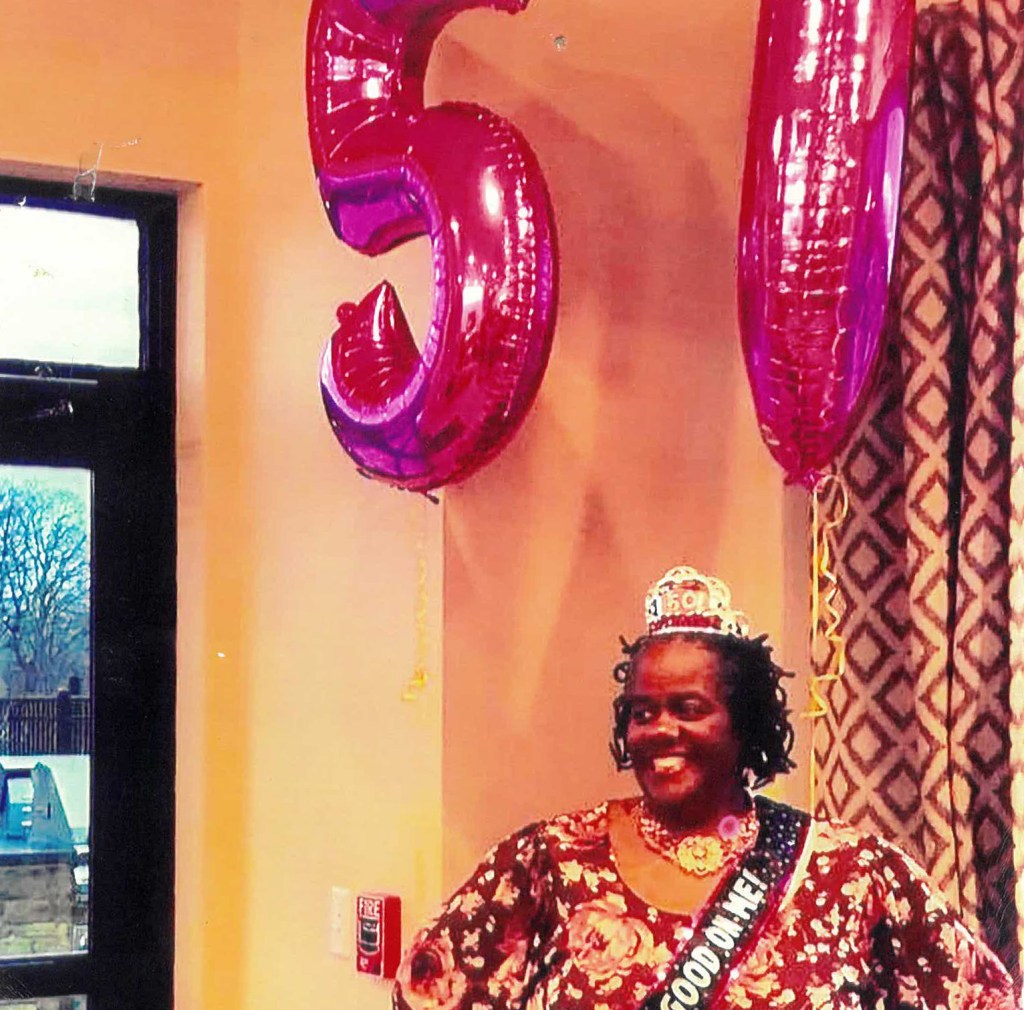
Shari with a crown, sash, and balloons on her 50th birthday in Massachusetts. (Photo by unknown, personal photograph, 2018)
Refusing Minnesota nice-ness & affirming Black feminist histories
I accepted an offer for my second clinical professorship at an institution in Minnesota and moved to the Twin Cities in April 2020—I was intrigued by all the post-George Floyd murder work, especially Black Lives Matter movement that I was reading and hearing about in the Twin Cities. It would take several more rounds of COVID-19 vaccines, multiple exhausting encounters of “Minnesota Nice-ness,” which I often experience as passive aggressive racial erasure at work and in the community, a diagnosis of COVID-19 induced arthritis and hair loss, and turning 55 to spur me to refuse to remain at a toxic institution which brought me to Minnesota in the first place. I left my job at the institution after two years.
In April 2023, I accepted a new administrator role at the University of Minnesota. I am currently a 3rd-year doctoral student in the College of Education and Human Development, Department of Curriculum and Instruction, Culture and Teaching program. I am also nearly 60 years old and feel better equipped to survive the process this time. I came to this program with the power of the hidden curriculum consisting of Black histories and memories taught and shared with me by my mom and dad, as well as their religious and political pride and influences. I also came to this program with my inspirational memories of resisting and refusing. All these stories and memories have already proven beneficial. While I do not believe my experiences are unique, I have encountered many obstacles while navigating this program. These include challenges in all aspects of doctoral studies: administration, advising, funding and instruction, which has been by mostly white men. My coursework frequently includes readings that center either deceased and old white male authors, often in the absence of content relevant to me that centers Black and/or queer women. Thankfully, the program, thus far, has also included learning and assignments which have afforded me the opportunity to seek out what I need.
Perhaps unsurprisingly, my research interest is reflective of my personal, professional and political experiences. Employing the love-centered, soul-feeding and embodied Black feminist phenomenological research methods that comprise collective memory work, I simultaneously combine the cultural artifacts of ancestral and historical Black culinary dishes across the African diaspora. My goal is to uplift Black students who already come to the table full of our ancestral stories and knowledges of resilience, resistance and refusals necessary for them and me to survive, but even more so for us to thrive.
Acknowledgments
Appreciation is not a strong enough sentiment. I am, first, most thankful to my parents. Next, thank you mom and thank you dad for all your sacrifices, for all your dreams and for all the inspirations by way of Black histories, Black memories, Black refusals and Black resistances. I would not be here were it not for you and all that you poured into me. Second, only in naming here, is my primary life purpose: my daughter, Zora. My life has been so much more enriched because of your presence. I hope I am doing a good job at being your mother and, more importantly, sharing and instilling in you all the dreams and inspirations which were instilled in me by your grandmama and pa-pock.
I love you.