
C. Kamana’okekai Lattig (KL) and pim gonzales (PG) are diasporic scholars who grapple with their respective ancestries through values they carry in their bodies. By reflecting on their autoethnographies together, they explore how embodied research can pave new horizons for their (inter)disciplines.
Arriving to the body as theory and method
KL: To introduce the conversation, I wanted to ask what it means to conduct embodied research. As scholars, I feel like we have the tendency to want to say things objectively, and we’re not taking into context the way that our bodies are reacting to or perceiving the things that we’re looking at. What about you?
PG: I think you highlight some important things that make me ask: What does it mean to learn how to do academic research? And when I’m thinking about courses I’ve taken on methodology and theory, I had to seek out scholarship that centered the body on my own. I was really fortunate to take feminist theory classes here at the University, where I read work from scholars like Amber Musser, who for me, modeled what embodied research looked like and its possibilities when we take seriously our bodily sensations and what our bodies intuitively can pick up on.
So embodied research for me is fundamentally a practice of intention because when we get into graduate school, we can get caught up in the performance of it, the “proper way” to write, to read and to convey what we end up finding in our analysis. But when we talk about conducting embodied research, we are making it a priority to center how and why we’re arriving at or approaching our research questions, our fieldsite and our archives.
KL: I think it’s interesting to hear you say that, because you are one of the people who really introduced me to this method of research because I didn’t really have that background. So how did you arrive at these research methodologies?
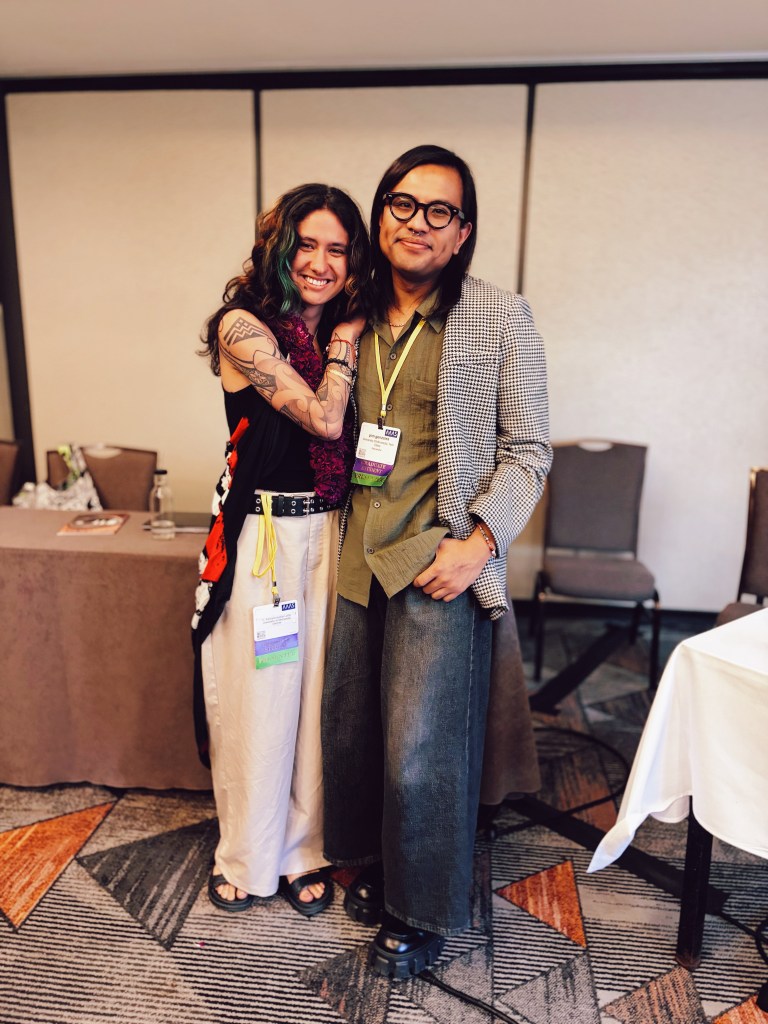
Kamana’okekai Lattig (left) and pim gonzales (right). (Photo by Janice Agustin, Honolulu, HI, personal photograph, April 2026)
PG: I leaned into learning more about how people come to know themselves and what internal forces move people to political action. It was through following that trail—listening to the impulse of what words can’t necessarily describe—that I ended up leaning into embodiment, and afterwards, a professor suggested that I look into feminist performance studies scholars. And I was like, “Oh, is that what I’m doing?”
KL: For me, I feel like it was a very natural pipeline. I was already doing research on hula practice, but I came at it as a Kanaka Maoli researcher who didn’t have access to hula practice in the diaspora. I was looking at it as an outsider, and what I realized is that I needed to take the next step forward to feel comfortable doing my research in an ethical way, and to put my body into situations where I was actively theorizing what I was thinking and feeling. So embodied research was just a natural trajectory for me to kind of go toward. And I think that I’ve definitely been doing a lot more recently, as I’m in a performance studies program now, so that has been really lucrative…not lucrative…generative for me.
PG: Now I want to know where you’re getting your funding to do embodied research.
KL: [Both laughing] Oh, yeah, my fat stipend, of course.
PG: That’s going in the books for sure.
I want to follow up on some things you just said: doing research in an ethical way and embodiment serving as the vehicle for your work. How would you distinguish what you’re doing and how you conceive of embodiment and the engagements that you’re having with the community from the practices of extractive researchers who will go into the field to immerse themselves in order to “fit in” with the people they’re studying solely to complete their research? I’m still wrestling with this idea of legitimacy or authenticity, and how the body and embodied knowledge enables different modes of knowing. Do you have thoughts on this, or does this matter?
KL: The belief that I’ve been trying to break down is that I have perceived myself as an outsider for so long. I didn’t realize it at the time, but I was understanding my research and my identity from Western perspectives of boundaries and authenticity. My interlocutors helped me realize that authenticity isn’t the same in my culture.
One of my kumus (teachers) that really helped me understand this told me that—because I was struggling with the distinction between touristic hula and what I called “authentic hula.” And he said, “Kamana, that’s not a thing, you know. Like, you can’t categorize hula practice, because when you’re saying authentic, it’s implying that there’s this kind of, this native—one specific version of hula that is correct when in reality even hula created for touristic spectacle, is still hula practice.” It’s just another form, and it doesn’t have the same roots. It just comes with that humility of knowing that you won’t ever know enough and that you’re always learning from your interlocutors, and that’s kind of the point.
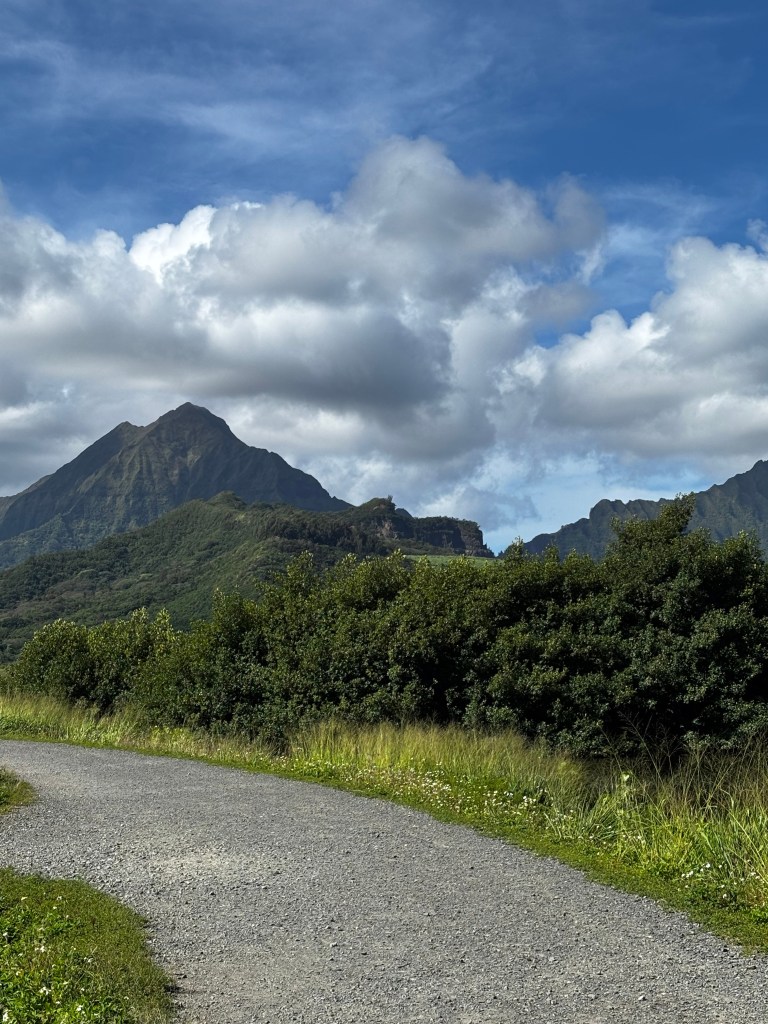


From top left: Landscape in Kailua, O’ahu (Photo by Kamana’okekai Lattig, personal photograph, April 2026); A loko i’a in Kona–this is a sustainable shoreline fishpond that Kānaka Maoli used for centuries before western imposition (Photo by Kamana’okekai Lattig, Kona, HI, personal photograph, April 2026); Speaking at an event, “Isang Bagsak: Palestine to the Philippines,” hosted by Indigenous Roots Cultural Arts Center (Photo by Len Sanqui, St. Paul, MN, personal photograph, November 2024); Kamana at Lili’uokalani Park around the time of the Mauna Kea protests (Photo by Shari Streutker, Hilo, HI, personal photograph, 2019).
Negotiating tensions
PG: I think that’s a great way for us to think about how we’ve wrestled with this “insider-outsider” tension in our own work—in this context of how we’ve practiced embodied research methods as we’ve grappled with our internalized contradictions.
KL: Yeah, that’s a good point. As members of diaspora, we have a very specific relationship—not only to the places that we reside in, which isn’t our ancestral land, but also to the ways that our bodies are perceived and the ways that we go about our day in a space that doesn’t belong to us. So, it’s a very interesting contradiction or messiness that we have to grapple with. Personal memories and reflections aren’t necessarily always positive, but they allow me to explore parts of myself (and contradictions) that I wouldn’t be able to without doing this kind of autoethnographic reflection. It’s very self-reflexive in the sense that we are looking back on these experiences and putting ourselves in these issues again while also theorizing the moment. So I think that is the way that I’ve been able to, I mean, it’s almost cathartic to be able to do that.
PG: What you just said reminded me of an important part of embodied research methods and privileging embodied knowledges—they go against this impulse to romanticize a pre-colonial fantasy or…thinking about the stereotypical, colonial ethnographer who is going to some “foreign land” to observe things that are “exotic” or “tribal” in the eyes of Western modernity. And on the other side, you might even have scholars who describe themselves as “anti-imperialist” who fall into the trap of romanticizing a history that is no longer recoverable.
Inherently, when we take up embodied knowledges, we are rooting ourselves in our bodies. For example, in our autoethnographies (which we’ll talk about shortly) we’re going back to a particular time in our lives, and we are trying to recall exactly what we were feeling at that point in time and how we relate to that feeling—that sensation, memory and emotion—to something greater—to make sense of how each of us have constructed our own senses of identity, of belonging, or what we want to do next in our journey. That’s a really important part of what you just mentioned, and for embodied research methods in general— that it takes seriously, without necessarily having to overcompensate with theory or with language that isn’t necessarily ours. We’re leaning into knowledge that we already possess and situating it within a broader context.
KL: Yeah, totally. That’s a great point. I wanted to ask why you chose that particular moment or those particular memories within your autoethnography to write about.
PG: There were a lot of different points in my life that I was considering. Like, where was my origin story of when I started to become aware of my own identity as something that was more than just eating chicken adobo and hanging out with Filipino friends at school. It’s interesting to look back at different experiences that I wrote about. For instance, I talk about how I used to be made fun of for being like a darker, brown Filipino, and at the time, I had no concept or critical understanding of what race was or what anti-Blackness was, but all I knew at the time was that it was uncomfortable and that I felt like I was an outsider. Although “middle school me” might not have known what to make of it then, “graduate student me” many years later is able to look at that, make meaning from it and connect it to the broader trajectory of my life.
I started to recognize that there were these moments in my life that I didn’t take the time to really understand or unpack what was happening, or I just didn’t have the language or the concepts at the time to think more critically about it. I wanted to include these little vignettes of different points in my life to draw a larger picture of how I ended up where I am today—to understand how I’m understanding diaspora today. My eventual dissertation—knock on wood—is going to explore conceptions of the Filipino diaspora that might widely differ from my personal understandings and experiences of diaspora. Unpacking my own senses of diaspora to build that foundational understanding ultimately led me to conclude my autoethnography with a recent experience: connecting my own understanding of personal identity in relation to the ongoing genocide of Palestinians by the Israeli “state.”
I talk about my arrest as a result of my involvement with the student movement for divestment from Israel. It took me well over a year to even put that to paper and to even consider what the greater significance of that was to me because it implicated me in so many different ways— including my “otherness” as a Filipino, as a darker-skinned Filipino, but also a gender non-conforming, transfemme Filipino who stood in solidarity with Palestinians (who are still) facing genocide and settler-colonial dispossession. I wanted to end by dwelling there because I’m still trying to think through what the body can do for us to understand diasporas occupying distinct sociohistorical contexts, each having different ways of experiencing violence, oppression, dispossession devastation.
I don’t want to flatten or conflate these contexts, and at the same time, there is something there in the body that links these experiences together. I’m not exactly sure what that is or how to articulate it yet, but for me, I know the body is going to be the site where that theory or understanding emerges. A very long-winded answer, but I think the autoethnography served not only as a personal reflection of key moments in my life that defined my current, critical understandings of my positionality as a Filipino American, but also how my gender identity was also implicated by these broader, ongoing global struggles.
KL: Thank you so much for sharing all that. I appreciate it.
To share an anecdote about this, it reminds me of, recently in Minneapolis, I was walking to campus, and I had to go past this station where I always get a little bit scared—you know, I don’t know why. It’s just an overpass, and it’s a little scary, it’s a little dark. But when I was walking under there, some guy pulled me over and asked, “Hey, can I borrow your lighter,” because I was smoking. So I let him borrow my lighter, and out of the blue, he just looked at me and he was like, “Are you Native?”
And I don’t know what compelled me to say yes, because that could be a dangerous answer, depending on the circumstances, and I said, “Yes,” and he told me, “You know, I get it. I understand what you’re going through.” And I didn’t really show any indication of distress or anything like that. But it’s like he knew, it’s like he felt that. And, I said, “I’m Native Hawaiian. I’m not Native American, I’m not from any of the tribes or nations around here.” He said, “It doesn’t matter if you’re Native. [Hawaiian]. And it’s the same struggle.” It awakened something in me—a realization that this struggle transcends the current moment. It’s something that we carry with us in our bodies.
I think that’s why embodied knowledge is so important, it does stay with us. You have this sense of intuition in your body, and for my culture as a Kanaka Maoli, I have those values that I carry with me—for my ancestors—that I maybe wasn’t cognizant of until I really started trying to understand them through theory.
PG: I remember while we were drafting, we wrestled with the practice of writing about ourselves: What do we include? Is this even worth putting in the document? Do I scrap everything and do it all over again? What was it like for you to wrestle with that process of choosing what to write?
KL: In this work, it is impossible to separate the personal and the professional, and I ended up landing on these moments that I chose because they were fundamental to why I’m doing the research the way that I am now. It was really difficult for me to write that because it’s just such a personal experience. It’s not that I haven’t shared it before, but I haven’t shared it in this way. But for some reason, I think that propelled me to share it even more because it felt important.
It’s something that I know I’ve talked to other Kānaka Maoli who shared this struggle and realization during the Mauna Kea protests that, yes, we really are Hawaiian. And it’s something that I wanted to share even further, because it’s very important to me. And I think that the concept of “feeling Hawaiian” is something that I’ve always thought about, but it’s not something that I really put much depth into because it does kind of sound absurd—like feeling Hawaiian, you know—and why? Why do I not feel Hawaiian? What makes there an absence of Hawaiianness, even though it’s in my blood and it’s in my family? I grew up with it, so all those things I’m coming to terms with now and really trying to theorize, and that’s why I thought those moments were really important for me to include.
PG: I’m really drawn to this emphasis on “feeling Hawaiian” because how do you even nail that to one thing, right? It makes me go back to the question of authenticity, which I remember you had mentioned earlier as this Western concept of being “authentic enough” to claim a particular identity or cultural practice.
KL: Authenticity is something that I just keep coming back to. But when I think of authenticity, I think of authenticating something. I think of it as a process. I think of something systematic and something that has to be approved, which implies that your Hawaiianness has to be approved of.
It’s impossible to separate the personal and the professional in this work.
I look back on my writing, and consider, you know what, what does it mean to “feel Hawaiian?” You’re right, it is a question of authenticity, and it does feel like I’m asking permission to feel Hawaiian, or that I only could feel Hawaiian because I was going to this protest—and I talk about that later in my piece—where it felt like I couldn’t replicate that feeling because I was not doing what I considered to be Hawaiian. And that’s also part of what made writing this so difficult: that urge to be “authenticated,” to approve and to put something into writing felt like I was constraining my Hawaiianness to something that needed to be approved by another set of eyes. I mean, it was difficult to feel like I was putting pressure on myself to approve of Hawaiianness, of my ability or capacity for Hawaiianness, and that autoethnography is me pouring out a lot of the feelings that I’ve had about what it means to appear a certain way, to be a certain way, to be approved of in a certain way. Ultimately, I think authenticity made it difficult to put these memories on paper.
Self-perception and irreconcilable loss
PG: In our autoethnographies, we account for a shift in perception of ourselves in relation to the world around us. Can you talk to us a little more about what that shift was for you? How did it feel, and how does that shift manifest for you today?
KL: So the shift in my autoethnography, and in the way that I’ve approached my identities in my life, came from protesting on Mauna Kea. This was the first time where I was part of a collective, not just a collective, but a collective of people who are Kanaka Maoli, and it was the first time that I felt Hawaiian. It became such an important feeling to me that I just kept chasing it. That shift, I think, is marked with that feeling of belonging to a group of people that all felt so connected. It was difficult for me to process what I felt afterwards, and I think that’s part of why I was so disoriented once I left the Mauna, because I had a taste of what I considered to be true, real connection with my culture and with myself and with my family, in a way that I had really lacked for my entire life.
Growing up in diaspora, I didn’t have access to anything that really made me feel connected. And honestly, a lot of times when I was able to visit family in Hawai’i, I was very privileged to be able to do so once every couple of years. And there were times that I didn’t want to go when I was really young because I had friends in school, or there was, you know, a cool school event in my elementary school and stuff like that prevented me from wanting to return to my homeland because I’d always felt this sense of grief visiting. So that shift in the way that I perceived my homeland kind of spurred me into action: to try and understand my culture a lot more, to reconnect with my roots, to reconnect with that feeling. And I compensated a lot for the lack of that feeling in the following years. It was really difficult for me to not have an outlet for feeling connected to my culture, and that goes back to desirability.
In diaspora, I had been perceived as attractive, I had been perceived as exotic, I’d been perceived as all these things that weren’t important in the grand scheme of things, and weren’t important when I was on the Mauna. Nothing else was important, besides the way that we came together. And I struggled with chasing that feeling because I was resentful towards the colonial impositions that made me and my body seem like some kind of commodity. And the Mauna was the first time where I didn’t feel like a commodity. So I came back to Oregon, and I was really horrible to myself, and I didn’t respect my body in the way that I needed to. What I’ve been learning now is that returning to those sensations does not necessarily have to do with being there on the islands. And it can’t mean that. It just can’t because so many of us are in diaspora. And another turning point in my academic career was realizing that.
PG: Just to connect to what you just shared about working with a collective on Mauna Kea and how it impacted your relationship to Hawaiianness: in your arrival to this “feeling Hawaiian,” I’ve come to understand that this feeling is fleeting. From what I heard from your stories, once you leave the island—once you are no longer there, once you inevitably have to say goodbye—you end up having to reckon with that physical separation, and then you’re reminded of that cultural disconnection as well. That this feeling is not necessarily a permanent thing that you can hold on to no matter how much we want to or crave that. And I think that’s an important point to talk about in embodied research, and that ties to the shift that I want to talk about in my autoethnography, and how I’m holding it today, is wrestling with these sensations, feelings, emotions…they’re not always happy.
KL: Yeah. Well, especially, you talk a lot about loss within your research and in your autoethnography.
PG: The shift that I wrote about in the autoethnography—I feel like I’m still in that shift as of right now. I account for gaining an awareness of colorism, learning about “nonbinary,” and beginning to identify myself as nonbinary and eventually trans.
It was through my engagement in collective resistance against the broader structures of U.S. imperialism (structures that we knew enabled and supplied the war machine with the means to destroy and to devastate Palestinian life and land) that this shift began: to understand my body in relation to others, not just through being Filipino, not just through being trans or being queer, but being in relation to other people who were angry, being in relation to other people who were tired from staying up all night at the encampment, to share stories and to laugh with one another, but also to cry and to fight for one another. For me, that’s where I started to develop these understandings of identity—that maybe this is what I was looking for all along, and the feeling of belonging that I never really got when I was pursuing this “authentic Filipino self,” or “authentic queer and trans self.” I always felt like I had one foot in the door, and at the same time, I always had one foot out—never really fully belonging to anywhere or anyone except for that moment of coalition building in the movement for Palestinian liberation.
But the reason why I say that I’m still in that shift is because the autoethnography didn’t have a happy ending, right? I’m recounting my dread as I was handcuffed and seated at the back of this bus waiting to be processed and held in county jail. My autoethnography captures me on this bus peeling off the red gel polish from my fingertips because I was so afraid of not being perceived as a cis man. And for me, I still am trying to reckon with—what does it mean when fights for liberation don’t lead up to this utopic future? Sometimes futures that we end up arriving to end up being really devastating. Because I’m sure “me” in 2023—when I arrived at transness and came out to an academic audience—wouldn’t have imagined that I would ever want to give up or shed the polish from my nail. I never imagined that I would do that, but in that moment I couldn’t keep my polish on. To me, it’s symbolic of letting go, but it’s also a material “letting go,” too. I physically removed this gel polish from my nail that was at once, a sign of gender expression and affirmation that were core parts of my identity. And at the same time, I let them go as soon as the nation-state had me in their clutches.
I physically removed this gel polish from my nails…a sign of gender expression and affirmation…as soon as the nation-state had me in their clutches.
KL: Yeah, I mean what it sounds like—and you can correct me if I’m wrong—you are simultaneously grieving for this version of yourself that wouldn’t have taken off that nail polish that was very defiant in that way, and also grieving for the future that could have happened where you could still be that person. Does that resonate with you?
PG: Yeah, it does. And I will say that I’m still actively thinking through what this means. I understand that the story isn’t over yet. Ever since my arrest, I’ve definitely stopped being so overt in my femme expression, perhaps just self-preservation. Or maybe you’re right, I could be thinking about that time where I had to shed my identity in a moment that I didn’t want to, but I felt like I had to. In a sense, it ties back to negotiating loss—loss of identity or loss of belonging. Whether we’re trying to negotiate our own selves, even away from ancestral land, away from or disconnected from family history or genealogy and the impossibility of recovering some forms of things that were taken from us—like, I’m never getting the red gel polish back.
What do you imagine the future is like from here? How do you plan on continuing to engage your body, embodied research methods and embodied knowledges as you continue to negotiate your relation to academia, as well as your commitments to the world at-large?
Embodied resistance toward collective horizons
KL: Yeah, that’s a great question. I mean, the body holds those things; it holds what our ancestors have gone through. And as people in diaspora, we have loss in our blood. Our parents for any number of reasons, our grandparents, or whomever it was that had to move from ancestral land, had to do that for a reason and experience that loss. And therefore, we’re experiencing that loss too, like I’m not on the islands and feeling the sun on my skin or in the waters that my people were created from. That is a loss that I feel and that has been passed down to me.
I think the direction that I’m heading in is understanding these losses not necessarily as a failing, but as something that gives us a perspective to understand the things that we are going through and that others in diaspora are also going through. It allows me to offer that empathy for those kinds of situations, even though it’s not something that I’ve experienced. I’m not going to speak for anyone who has experienced forced migration and losing their homeland in a way that that is currently happening now, but it is a perspective that is in our bodies and has been passed down to us.
PG: I think that hit some areas that I wanted to finish up with. There’s a lot of collective grief in the world right now, and I think for many of us, this grief is constantly transforming as we face these concurrent devastations and escalating destructions—to sit with the grief of losing what we can never truly recover, and we have to accept that we can never go back to this romanticized version of diasporic identity—that maybe one day after enough research or after enough exposure, that we would feel at peace with being a part of diaspora.
What I’ve ended up reflecting on through this conversation is that these feelings come in waves, our senses of belonging and not belonging. But most importantly, I think, is the importance of finding rootedness in collective resistance, to indulge in a collective sense of community that isn’t just built on taken-for-granted identities, but to relate to one another in our empathy and understanding of how we’ve been impacted by the legacies of settler-colonialism and empire.
Part of me still hopes for a future where—you know, maybe sovereignty is real and attainable. I don’t know whether imperialism and the impacts of settler-colonialism will fade away into the abyss, and I recognize that this struggle will probably not end in our lifetimes. But just because it’s not going to happen in our lifetimes doesn’t mean that we shouldn’t struggle for and aspire to it. I mean, the body tells me that that is worth fighting for.
Just because it’s not going to happen in our lifetimes doesn’t mean that we shouldn’t struggle for and aspire to it.
KL: I mean, that’s a beautiful way to end it—with this, this uncertain horizon, especially where we are at, politically and socially, in Minneapolis, Minnesota, in March 2026. We can keep fighting for that potential horizon and continue to create community and connections in a meaningful way. Because at the end of the day, that’s our identity. It doesn’t mean anything without its relation to others. What we are able to accomplish in our lifetime doesn’t have to be this great utopia that, of course, we do want, but we can still make it better. And we can exist and commune with each other in a way that is still meaningful and beautiful despite everything that’s happening. Thank you so much for having this conversation, pim.

Kamana’okekai at Kukio Beach, directly behind the Four Seasons Resort. (Photo by pim gonzales, personal photograph, April 2026)