
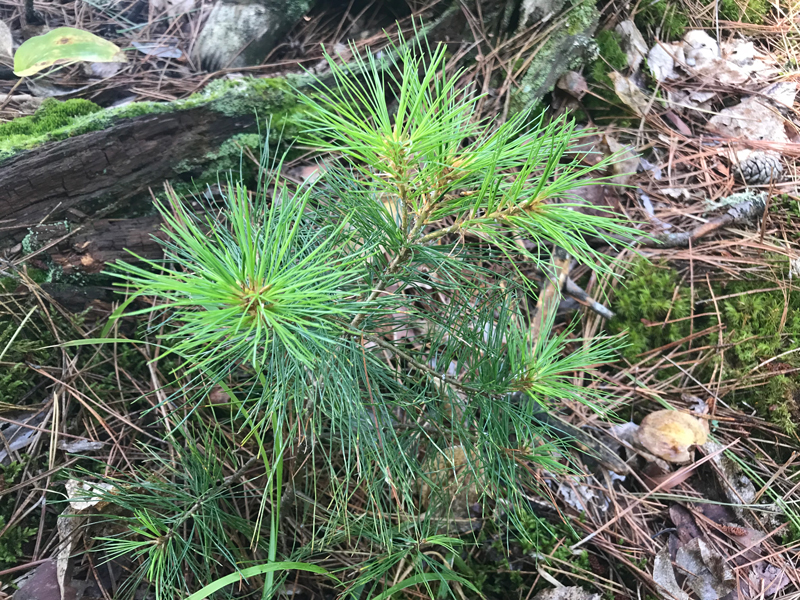
Bapakwanagemagoons saplings (Pinus resinosa commonly known as red pine), are dependent upon fire for regeneration and only commonly found in areas where fire occurs on a regular basis. Where there is absence of fire for long periods of time, saplings are rare. (Photo by Nisogaabokwe Melonee Montano)
Boozhoo indinawemaaganag. Minogiizhigaabo indizhinikaaz, Gaa-Miskwaabikaang indoonjibaa, Migizi indoodem. The name that I was given when I was just a few days old is Standing in the Good Sky. I come from the “place of the red cliffs” or the Red Cliff Band of Lake Superior Chippewa. I belong to the eagle clan. My government name is Bazile Panek. At the time of writing, I am working towards my Masters of Science in Natural Resources Science and Management and a Ph.D. in American Indian and Indigenous Studies.
Boozhoo indinawemaaganag. Nisogaabokwe indizhinikaaz, Gaa-Miskwaabikaang indoonjibaa, Migizi indoodem. I am known as Three Standing Women which is my Ojibwe name I was given through ceremony at a very young age. The place I call home is Red Cliff which is on the southern shores of Lake Superior. I am of the eagle clan. The name my parents gave me at birth is Melonee Montano. At the time of writing, my efforts are also focused on both a master’s and Ph.D. in natural resources science and management.
We arrive at this work through our connection with each other, as mother and son. Our connection and kinship relations influence how we write this piece and the stories we share. Kinship is an incredibly important part of being Indigenous and within it, there is power. We are harnessing this power by leveraging the deep connections we have with each other to write from not only the mind, but the heart.
For generations, the Anishinaabeg, an Indigenous peoples that surround the Great Lakes region, have held and continue to hold knowledge transferred through oral methods and traditions, and preserved in minds and hearts. Imagine being told a sacred story, knowing that you weren’t going to write it down, and how important it would be to listen intently so you don’t forget the sacred knowledge. Within this piece, you’ll find personal dialogue in which we reflect on who fire is, how we interact with them, how we can seek a reconnection to them, and our work as an effort to do so. Writing down our conversation is our attempt at honoring oral tradition.
We start this piece with the origin story of fire rooting us to the past in order to inform our present. The Anishinaabe origin story of fire is a story that continues to be shared through generations. It reminds us to be grateful for how fire was given to us and to recognize its origins in our work today.
Included are audio recordings of this origin story and our conversation. The audio matches the slightly edited text so you may choose to follow along while you listen to the audio.
Imagine being told a sacred story, knowing that you weren’t going to write it down, and how important it would be to listen intently so you don’t forget the sacred knowledge.
The Anishinaabe Origin Story of Fire
The Anishinaabe Origin Story of Fire, orated by Nisogaabokwe Melonee Montano
Mewinzhaa, long ago, the people were cold and hungry and without access to fire to use for warmth and overall survival.
Nearby, there was a bird in a tree observing the people. This was Aandeg, the crow, who had beautiful feathers that shimmered with all colors of the rainbow and a voice that serenaded all those around them. While observing the people, Aandeg noticed how the people were suffering, and decided to help them.
Aandeg decided to travel to the Creator to ask how to help the people stay warm, despite the cold. The Creator, seeing how much Aandeg cared about the humble people, decided to share some Ishkode (fire) with Aandeg by passing over a burning branch. Aandeg then took the branch and began to travel from the Creator’s home back down to the earth. As he traveled, the burning branch burned hotter and hotter. It started to hurt Aandeg and scorch his feathers. He flew faster and faster and called to the people to tell them to be ready for the gift that he was bringing. By the time Aandeg finally arrived, the fire had scorched and blackened Aandeg’s feathers and burned his throat, making it harsh and raspy.
Despite the scorched feathers and throat, Aandeg began to share the story of fire and instructions on how to use it. He shared how the fire will keep the people warm, help them cook, and how it can provide growth, bring about food, and help forests. Aandeg shared this gift with the people, sacrificing his rainbow-colored feathers and his soothing voice for us.
Next time you pick up a crow feather, hold it up to the sun and you will notice shimmers of blue, green, and other colors, which are the remnants of the rainbow feathers that Aandeg once had. This story can serve as a reminder to be grateful to Aandeg for the gift of fire.
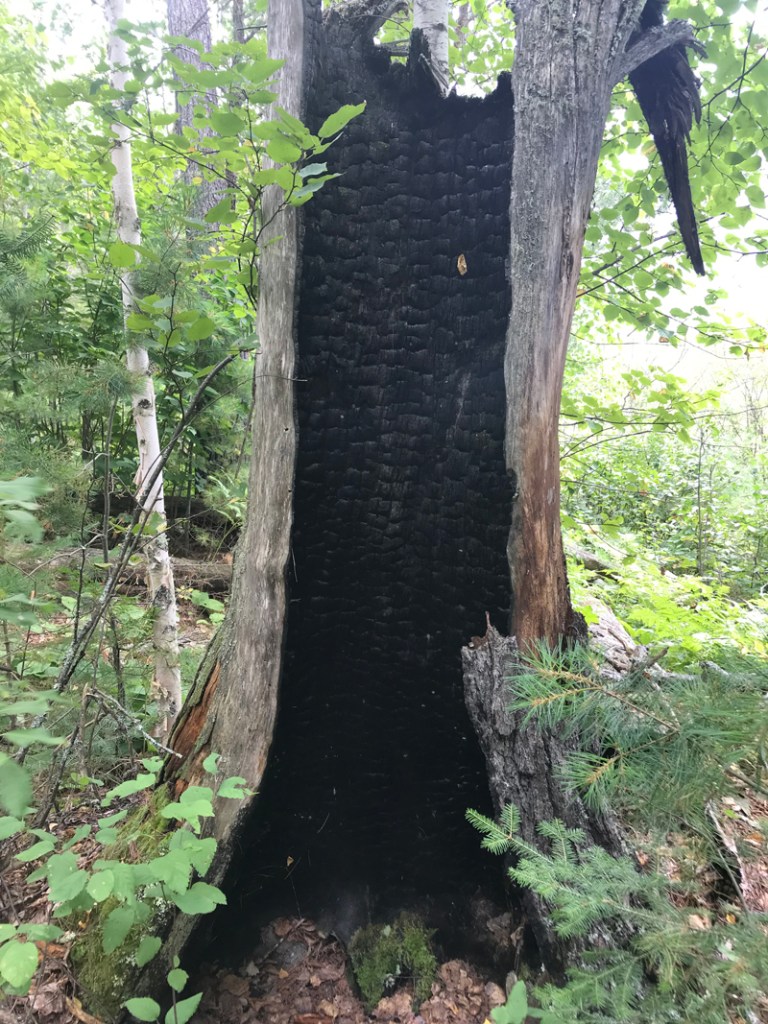
Evidence of both fire and renewal on a landscape can be seen in trees such as this one found on the lands of Gakijiwanong Anishinaabe Nation (Lac La Croix First Nation) in Northwestern Ontario, Canada. (Photo by Nisogaabokwe Melonee Montano)
Reflective Conversation Between Mother and Son
Reflective conversation between Bazile Minogiizhigaabo Panek and Nisogaabokwe Melonee Montano
Bazile Minogiizhigaabo Panek
It may be important that we start with this existential question of what fire actually is. There’s so many ways you could put that — you could answer it from a scientific perspective, you could answer it from a cultural perspective. I’d like to hear from you what fire is from a cultural perspective.
Nisogaabokwe Melonee Montano
It’s a good question, because I think about culture and I think about fire, and that leads me to not what fire is, but who fire is. For us as Anishinaabeg people, we see fire not just as this element, but also as this being. Fire has its own spirit, and different communities have different names for fire, like the Lac La Croix community in Ontario, for example, they have a particular name for that Spirit of Fire and other communities have other names, which speaks to the cultural significance of who fire is. Rather than this thing, rather than something to serve us, fire is that gift that comes out in that origin story, and it was this being that was brought to us to help us survive, to keep us connected with each other, to help grow food, to be present at all of our ceremonies. It’s this being that is part of each and every one of us, not just as Anishinaabeg people, but as humans on this earth, and therefore we have a responsibility to take care of this being while we’re here too, and be students of Ishkode and learn everything that we can about Ishkode.
Rather than this thing, rather than something to serve us, fire is that gift that comes out in that origin story.
Bazile Minogiizhigaabo Panek
I’ve always heard that too—that fire is a spirit and fire is a being. I think there is a lot of autonomy of fire that we should respect. During our prescribed burns, we should, in a perfect world, allow fire to practice how they want to practice, to be how they want to be, to spread across colonial borders and not have these rules and regulations imposed upon them because they are a spirit with autonomy in their own way of being and knowing. I wish we could respect that more. There are some ways that we are working to respect that and allow for fire to practice that autonomy. I think this origin story is important in that regard, because we can see that the Creator was holding this, the Creator was holding this special being that was such a gift to the people that it was incredible how big it was for the humans to have this. The Creator was holding on to this, and it was only after this long journey of the crow that the Creator was willing to pass this over to them. What does this origin story specifically mean to you?
Nisogaabokwe Melonee Montano
We need to walk with respect and humility and always remember that our lives can be taken at any moment.
Well, one, I think the story within itself is so beautiful and I think that there’s so many lessons to be learned within it. On the surface, obviously, that fire is here to help keep us warm, help us to survive, as I mentioned earlier. But I think you know, there’s deeper meaning within that too, and it speaks to relationality and responsibility, how us as humans are interconnected with the more than human relatives around us, the plant relatives, the tree relatives, the Manidoonsag (insects) and water, fire, all of those ones. I think that speaks to how we need to remember to carry ourselves as humans and how we need to allow a good positive space for those things, such as fire, but also a responsibility to creating that space for them and taking care of them and letting them take care of us. That goes back to some of our original teachings too, to take care of those and they’ll take care of us.
I think that some of the deeper meaning that this origin story gets at is that responsibility of caretaking, but also how we’re all relatives here on this earth. It’s not just us as humans. We’re not the ones that hold ultimate power. Fire can both give and take life. We need to walk with respect and humility and always remember that our lives can be taken at any moment. But also remember that we need fire here to be able to not just take care of us, but to bring forth more food on this earth and continue beings such as red pines and some of those other ones. It’s not just about our own survival, but the survival of all that’s living and breathing upon this earth.
Bazile Minogiizhigaabo Panek
Since I’ve been hearing this story for years and years, since I was younger, I have always felt that there is this certain amount of responsibility that we get from knowing the origins of fire that Aandeg had sacrificed a lot in order to give this very incredible gift to us. I do feel that responsibility to follow those instructions that Aandeg gave us. They instructed us to use fire with the land, use it as a land caretaking tool, and bring fire to our landscapes that miss it. We have not been able to honor those instructions. We haven’t been able to honor those instructions because of the fire suppression policies that have been implemented by the colonial rule, and the absence of cultural ignitions caused by the criminalization of them.1 We haven’t been able to honor these instructions, and I do feel that that’s unfortunate, it’s sad, and it’s disrupting our relationship with fire.
Hearing the origin story again today, while there have been some changes made and we are burning quite a bit more, it does give me a certain amount of hope that we are again honoring those instructions. We are honoring the being of Aandeg. We are honoring fire. We are honoring the Creator who gave us this gift. I think we’re, we’re getting closer to enacting that full responsibility.
Nisogaabokwe Melonee Montano
Thinking about that is really empowering, because when you think about being disconnected or dismembered, or even the concept of a forced removal from our responsibilities of being present with fire, taking care of fire, that’s all, as you speak about, due to acts of colonialism. That has not just impacted us and our connection with fire, but the ability for fire to hold itself in that good way on the landscape. What we’re faced with now is, in the light of climate change, all of these drastic, tragic fires where you are in areas where you haven’t seen fire for a long period of time, and so there’s obviously going to be a lot more fuel2 there, and fire is going to come in, and it’s going to become tragic real quick because it’s been away for so long. That speaks a little bit about not just us being disconnected from fire, but fire itself as that being is disconnected from the landscape.
This leads me to think about, you know, our work in our region, in the Wisconsin, Minnesota, Michigan region specifically. There’s a group of us that have basically dedicated ourselves to several causes, but the main ones as a collective being, looking at one, the fire history in our region, and two, helping in efforts of returning fire to this area.3 Through the lens of fire history, we’ve seen the fire scars match up with the fire suppression policies. Fire was present on a regular basis in this region up until the mid 1800s to early 1900s and then it stopped. Every now and then you might see a real large fire that leaves significant scarring on the trees. What you’re not seeing is those regular fires that we used to have. Prior to the mid 1800s in our region, we would see fires occurring on a regular basis every five to seven years. With the research that we’ve done, it’s shown that there’s a direct correlation to the people in this area that had been burning, which is the Anishinaabeg, or Indigenous people of this region. Since it had stopped, that’s really creating some shifts.
Through looking at that fire history, we’ve been taking steps in a few different directions towards those efforts of returning fire. One of them was applying to the National Science Foundation to obtain funding to go into tribal communities specifically and learn about what their wants and needs are surrounding fire and how we can help them return fire. As you know, when it comes to research, all too often, there’s a lot of extractive research that goes on, or folks impose what they think is a good idea for a community, and then they decide to carry out research, and it’s really not something that’s helpful to that community. Our tribal communities to this day, are facing things such as climate change events, main highways in and out being washed out, or severe drug addiction, health disparities and so many other things. They don’t really have the time to look at just the ability to return fire, but in the meantime, they still face that disconnect in every part of their lives.
We’ve been hearing from the communities what we can do to help return fire, with them and for them, and also if it’s something that they even want to do or not. Some communities are simply just returning to their actual inherent connection to fire. Many of them still carry stories about the use of it on the landscape, such as elders burning in the area for things like blueberries and they remember the blueberry picking.4 Those acts were occurring only up until the early 1900s when it became illegal to do so. Some of those communities, as a result, have historical trauma they have to push through as well. I know that you’ve been a collaborator on that project, too, and so as one of the younger individuals coming into our group, I think it might be great to hear your thoughts on what that experience has been and what type of other work it’s led to as well.
Bazile Minogiizhigaabo Panek
I’ve been honored to be the coordinator for this project where we’re bringing listening sessions or talking circles, or what we’re calling Fireside Conversations to these communities. It is amazing to see how many community members are interested in the return of fire. They express this deep connection to it, whether it be they learned how to start a fire in a wood stove from their grandpa, or that was their heat for years and years, or they just learned how to cook on a fire for the first time. Everyone has their own sort of connections. It could even span to like someone who is a prescribed burner that has years and years of experience. There’s a lot of varying levels of connection that people have to fire, but whatever that level of connection is, they do have a base level connection, an inherent connection that goes deep into their being. That’s really exciting for me to see. It makes our jobs easier to hope to return fire to the landscapes that miss it. It provides further opportunities for us to educate the communities and bring them along with us in this journey to return fire to the landscape.
We’re trying to honor our future generations in this work. We’re trying to ensure that the future generations will have these amazing fire dependent and adapted landscapes that have seen fire in recent years and have healed because of it. That’s the goal we’re trying to do on a project where we are looking to return fire to Minnesota Point in Duluth, Minnesota, and that has been going really well. We are looking to do that pretty soon. That has been a project that has required a lot of collaboration from various different entities and organizations and community members and the Fond du Lac tribe as well. So that is really exciting. I think overall, we’ve covered quite a bit about what our efforts are and the responsibilities we feel from the origin story. I think there’s nowhere to go from here but up in our use of fire and our return of fire to landscapes that miss it. I think this is all really exciting work that I’m happy to continue on with.
Nisogaabokwe Melonee Montano
It’s an honor to be able to do it intergenerationally as well. I think that those more-than-human relatives around us, I’m sure, are celebrating seeing many of us coming back into this work and picking up those responsibilities, but also doing it interconnected through generations, and in this case with Mom and son. I think that that’s extremely moving. I imagine those red pines and blueberries and all those ones to be celebrating when we arrive, when we get to the point in those areas that we have so far and will be in the near future to return fire.
Bazile Minogiizhigaabo Panek
That’s a beautiful thing to imagine, and I hope they’re happy with our work. This has been a great conversation. I’ve really appreciated thinking about this and reflecting, and it was really good. Miigwech.
Nisogaabokwe Melonee Montano
Chi miigwech.
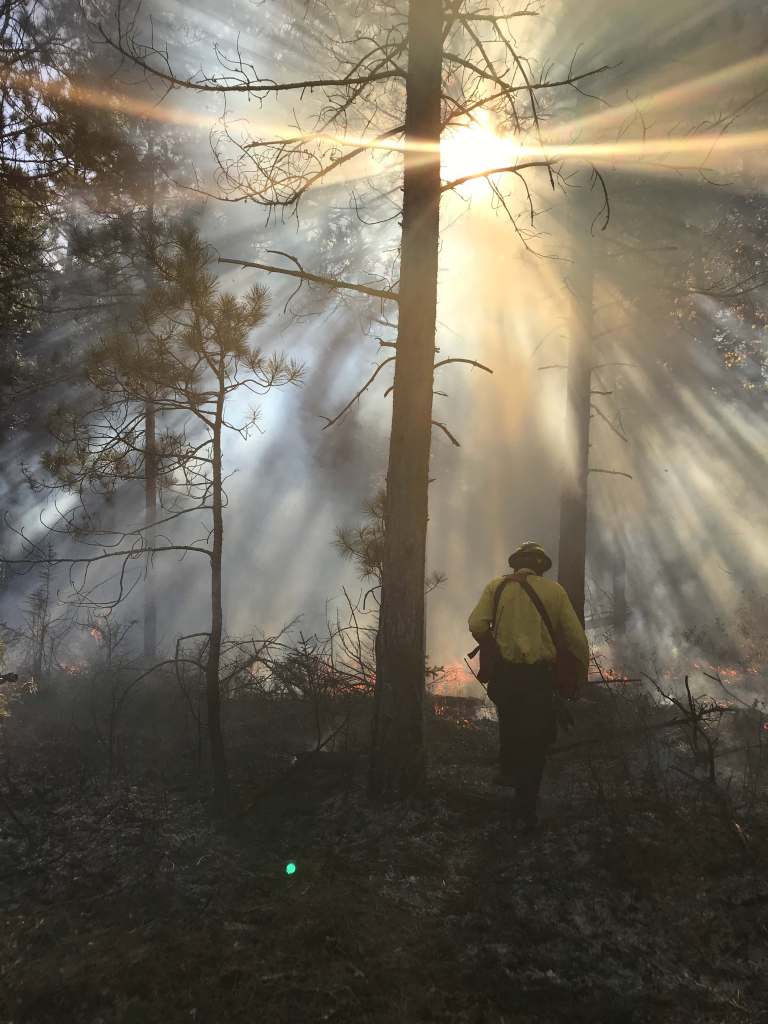
We’re trying to ensure that the future generations will have these amazing fire dependent and adapted landscapes that have seen fire in recent years and have healed because of it.
Signs of nature celebrating the return of fire can be seen in sun rays shining through this cultural fire held on Wiisaakodewan-minis (Stockton Island) on the southern shores of Lake Superior just north of Red Cliff Wisconsin in 2017. (Photo by Nisogaabokwe Melonee Montano)
- Fire suppression is a total extinguishing of fire. Fire suppression policies implemented in the early 1900s exhibited all fires as bad, in part because fire threatened the profits of the timber industry. This led to charging or jailing Indigenous peoples who intentionally set fire on the landscape which included cultural burns. Cultural burns are controlled burns set by Indigenous peoples according to cultural values and objectives that aim to improve the landscape’s health and deepen the human relationships with the land. ↩︎
- Fuel is organic material, such as pine needles or dead and downed trees, that burn in a fire. ↩︎
- The collective is an informal collaborative group of fire researchers, practitioners, and knowledge holders working together to return fire to the ground in Minnesota, Wisconsin, and Michigan. ↩︎
- Fire creates healthy habitat for blueberries and can increase production. See J. B. Anderton, “Native American, fire-maintained blueberry patches in the coastal pine forests of the northern Great Lakes,” 6, no. 1 (1991): 29–39. ↩︎