
As graduate students at the University of Minnesota Twin Cities, we are witnessing, living through, and actively resisting against the unlawful military occupation of Minnesota by Immigration and Customs Enforcement (ICE) agents deployed by the Trump administration, all the while we are expected to continue navigating our programs, research and teaching obligations. In navigating this contraction as members of the Kānaka Maoli and Filipino diasporas, we propose that it is crucial, now more than ever, to attend to our bodies: how we physically exist and resist given our current socio-political conditions. We contend that we must honor the knowledge we carry through our bodies, rather than neglect it. The diasporic body is entangled in overlapping impositions; we navigate our positionality as displaced Brown-bodied scholars who walk through South Minneapolis to get groceries and go to work amidst tragedy, which is akin to that which displaced our peoples to begin with. Not only do we believe that it is crucial to highlight the significance of embodied forms of diasporic knowledge, we argue that it is by taking these forms of knowledge seriously that we are able to relate across different diasporic contexts without flattening experience.
Thus, we recognize our role in academia—an institution that carries certain structures and processes that regulate who is capable (i.e., worthy) of producing knowledge—and that it appraises certain forms of knowledge as more or less valuable (i.e., legitimate) oftentimes based on expectations around research praxis. As graduate students, we are expected to learn how to navigate this terrain, even while the illusion of Western democracy unveils itself to the masses in its race to collapse: the horrific violences that have disproportionately impacted marginalized groups in the United States and throughout much of what is understood as the “Global South”—including Indigenous peoples, migrants, people of color, those with dis/abilities, the working class and other groups outside the bounds of cisheteronormative society—are becoming increasingly indiscriminate. We address these tensions in two parts: the first will solely feature autoethnographies from Kamana and pim (in that order); afterwards, we engage each other in conversation to discuss the resonances, dissonances and ambiguities that emerge across both of our accounts.1
“My insistence on conjoining flesh and knowledge emphasizes theorizing as a fleshy activity, both because theory emerges from flesh—positionality matters—and because theory is enacted by bodies; thought can be located outside of the linguistic, in and through the body and its movements. This rescripting of what counts as knowledge is both a rebuke to the demands of fixity and transparency…and an invitation for us to rethink what counts as minoritarian knowledge production.”
— Amber Jamilla Musser, Sensual Excess
Reclaiming the diasporic body—Mo’olelo o Kamana
Ever since I was little, I was told my body was “special.” That I was pretty. Thin. That my skin made me something that not everyone could be: exotic. Hawaiian. This was fascinating to the rural white town I grew up in. When I was six years old, a boy I had a crush on told his brother about me. He said, “You better hold onto that one. She’s going to be beautiful when she grows up.” I didn’t learn that he said that until I was graduating high school. Really? He thought I would be beautiful? Looking at myself as a high schooler, I didn’t believe it: I was awkward, too loud when I was supposed to be silent, too quiet when I was supposed to talk and I had the lankiness of a neurodivergent kid that was destined to be made fun of behind her back. I knew little about being Hawaiian, but at that point I thought that to be Hawaiian was to be beautiful.
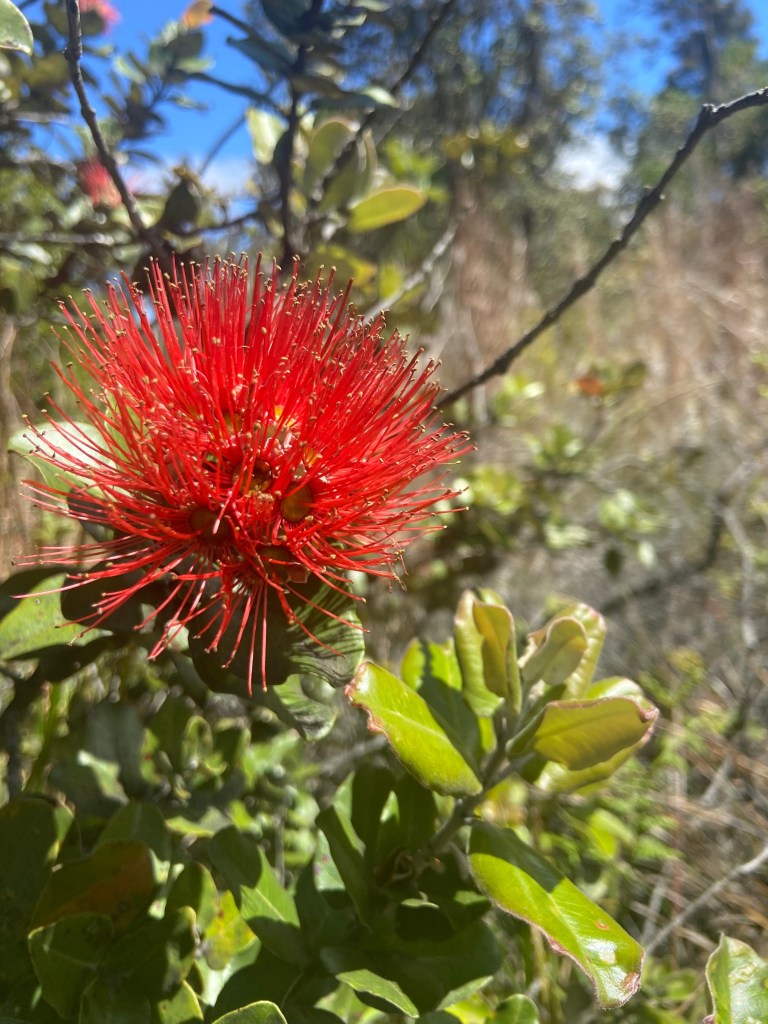

Left: A photo of a lehua. (Photo by Kamana’okekai Lattig, personal photograph, June 2024). Right: Kamana’okekai at Kukio Beach. (Photo by pim gonzales, Kona, HI, personal photograph, April 2026)
I walked through life thinking I wasn’t Hawaiian because I wasn’t beautiful. My auntie, Tia Carrere, is beautiful—she’s a real Hawaiian.2 She knows how to dance and sing, and wears the flower lei on her neck like she is a princess, not like it’s trying to smother her. I clammed up when I talked to other Hawaiian girls—they were way prettier than me. How could I talk about being Hawaiian when I didn’t deserve to share the same space as them? They had the confidence and the beauty to claim their identity. I didn’t. I felt that my identity was claimed already by everyone else around me who wanted “Hawaiianness” to feel like unwanted hands on my waist and lingering gazes.
In a way I was onto something: Hawaiian identity can be felt through the body. The first time I “felt” Hawaiian was protesting on Mauna Kea in 2019 and it had nothing to do with appearances. A switch clicked—I stood with my family, side-by side, as the crowds of Kānaka Maoli chanted and sang in unison. I knew none of the words, but it didn’t diminish the feeling this gave me—the feeling that I was a part of the lāhui, physically and mentally. It felt like butterflies in my stomach, but so much more; I felt the presence of my ancestors inside of my body. I was exhilarated and nauseous and quaking in my slippers all at once. I felt connected to the “aina,” in the same way my kupuna and ke Akua were standing with me. I knew at that moment that my body really was special—but not like I was told my whole life by the people who saw me as an object. It is special because it is protected, strengthened and inspired by my ancestors who came before me. It is special because beyond belonging to me, my body situated me in my family’s lineage.
I’ve struggled for years to replicate the feeling of my ancestors in my body devoted my academic career to understanding that feeling. However, at the same time, I also neglected my body’s health and tried to destroy parts of myself I didn’t like. I starved myself, wore “Hawaiian-looking clothing,” bought a tribal tattoo, and did everything I could to compensate for the hole in my chest that I didn’t know existed until after the Mauna. I researched, wrote papers and read books about being Hawaiian.
I’ve struggled for years to replicate the feeling of my ancestors in my body. Devoted my academic career to understanding that feeling.
The second time that my body reacted like it did on the Mauna was, unexpectedly, in a mosh pit of a Minneapolis DIY show several months ago. I frequent punk shows and have always considered that as an identity separate from my Hawaiianness. The mosh pit itself is cathartic: we crash our bodies into each other in violent ways. It has always been a place where I can blow off steam, but I took a step back to smoke a cigarette and watch. Two fem-presenting individuals pointed at each other from across the room, sprinted and started fighting. They were giggling afterwards and a friend dropped their cigarettes in the pit and someone handed them back immediately. A small trans individual fell, and three people picked them up. The feeling in my body returned, but this time I realized that it came from some of the tenets of Kanaka Maoli culture I’d been studying on paper: laulima (taking care of one another), lāhui (community building), and kuleana (playing a role for your community). The presence of my ancestors came from embodying those ideals, not from participating in a Hawaiian cultural practice in the way I perceived it. They are ingrained in the body, passed down through generations. My kupuna showed me that to be Hawaiian meant embodying those tenets, and to do so I needed to take care of my physical form as well. They taught me that all I needed to do was reach inside myself to find them.

pim (left), Kamana (center), and Kamana’s brother (right) at the barricade for a Silverstein concert. (Photo by pim gonzales, Minneapolis, MN, personal photograph, November 2025)
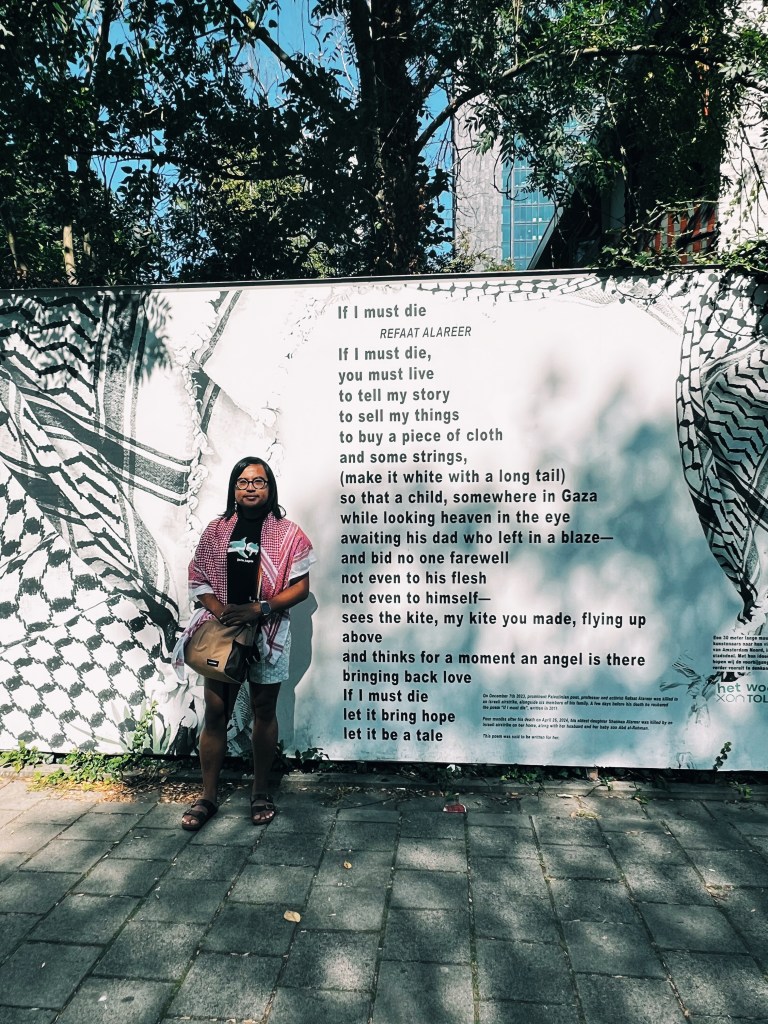
Mural featuring Refaat Alareer’s poem, “If I must die.” (Photo by pim gonzales, Amsterdam, NL, personal photograph, August 2024)
On transfemininity and forsaking the “X”
My mother immigrated from the Philippines to the United States in the 1980s, where she eventually married my dad and gave birth to me a decade later. I was born in Honolulu, Hawai’i, but I hold no memories of my short-lived experience living there. A divorce led my mother and I to fly to the continental U.S., landing in Las Vegas, Nevada, where I spent the bulk of my formative years. There was a particular irony with me sharing a similar genealogy with other 2nd-generation Filipino Americans—parent(s) born in the Philippines, migrating to Hawai’i, then somehow landing in the deserts of Las Vegas3—and yet, feeling little in common with them.
Early childhood convinced me that I did not belong in my body. My mother would have me attend a private Catholic school for my last couple of elementary school years with hopes that I would “learn how to be a good person.” I mostly learned that I wasn’t good at sports (i.e., not like the other boys), and I never understood why the girl uniforms were more fashionable than the boy uniforms. In middle school, friends joked around with me being one of the darker-skinned Filipinos. I would feel even more self-conscious about this when I returned home to find papaya soap4 next to my bathroom sink. My darker skin marked me as less desirable and more worthy of ridicule, even among my Filipino friends and Filipino mother. Frantz Fanon described this phenomenon succinctly: it was an “epidermalization” of inferiority, an inferiority inscribed upon “the [racialized] Other” based on skin color.5
Ten years later, I found myself writing my master’s thesis, in which I investigated the colonial histories of the Philippines and the violences that Filipinos had to endure and resist for over three centuries of occupation. At the same time, discourse around the term Filipinx, as a proposed gender-inclusive alternative to Filipino/a also resurfaced. Critiques posed towards the “X” helped me learn more about gender identities beyond the binary, and simultaneously the X offered me a new point of connection with being Filipino. While the COVID-19 lockdown brought the world to a crawl during the first quarter of 2020, I found the courage to specify “they” as a pronoun on my university email signature. Clicking the “Save Changes” button on my browser window brought about a feeling of vindication, knowing all along that I was right about using the singular “they” in my English essays. At once, I had the language to describe feeling stuck between masculinity and femininity, perhaps beginning to see the gendered contours of Gloria Anzaldúa’s “borderland.”6
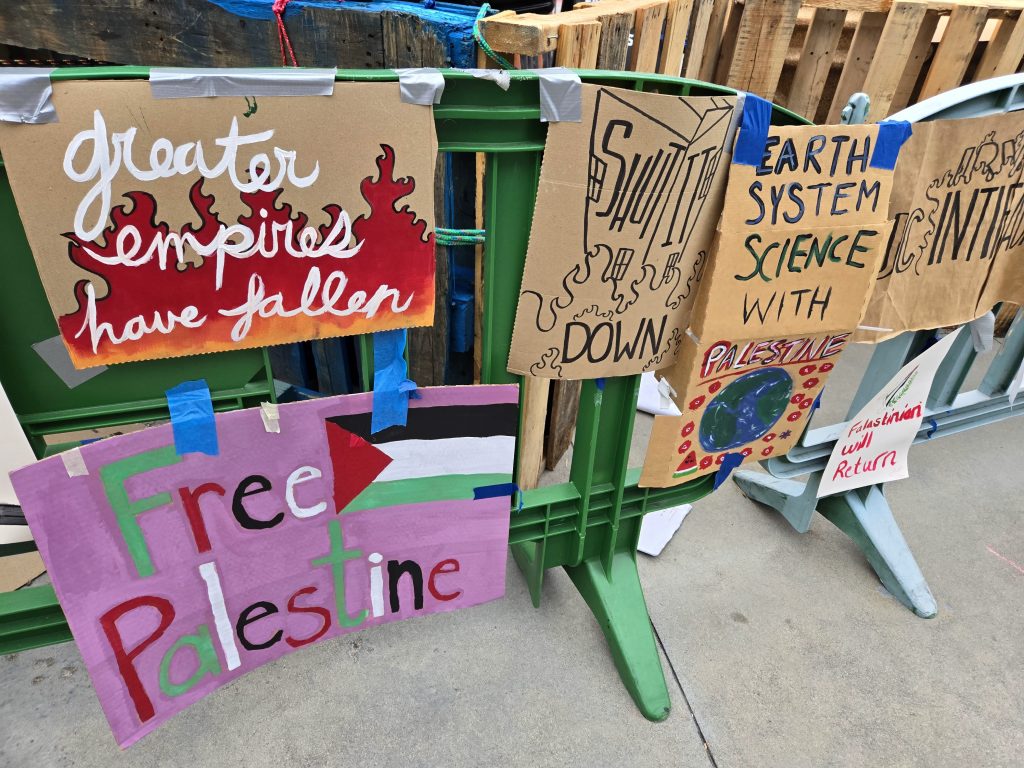
Barricades adorned with political posters surrounded the student encampment. (Photo by pim gonzales, undisclosed location, personal photograph, May 2024)
In the years to follow, I would begin to understand the magnitude of this decision. Not only did my adoption of “they” reshape how I perceived myself and my gender, but this choice completely shifted how I moved about and sensed the world across multiple vectors of my identity and self-expression: most pertinently, my background as a 2nd-generation Filipino American who claimed to be a cisgender man for most of my adult life up to that point. I slowly began to replace my wardrobe, eventually donating all of the clothes I thought were “too masc” in favor of soft blouses, wide-legged pants, and wedges. My spirit began to swell with confidence. It was at the conclusion of my first conference presentation as a Ph.D. student in the spring of 2023 where I came out as transfemme in a room filled with colleagues, faculty and strangers.
Not only did my adoption of “they”reshape how I perceived myself and my gender, but this choice completely shifted how I moved about and sensed the world.
One year later, in the spring of 2024, I stood alongside student protestors in a stand-off with over twenty police departments who were called by the University’s administration to sweep the student encampment established in opposition to the University’s complicity in funding Israel’s genocide of Palestinians in Gaza and the West Bank. Once officers were directed to advance towards students, I was jabbed with a police baton, dropped to the floor and was handcuffed. My face felt the concrete floor of the courtyard and my wrists felt the soft, yet rigid, plastic zip-tie that bound my hands behind me.
My body was no longer under my control: two law enforcement officers gripped each of my forearms and escorted me to be processed by university police. A fem-presenting officer began questioning me and removed my helmet, goggles and face mask. After a brief moment, they handed my paperwork to a masc-presenting officer, who then proceeded to physically touch me to confiscate the rest of my belongings. I realized at this moment that they read me as a “male.”
On the bus to county jail, I was seated with other men at the rear of a bus. One of them noticed the polish on my nails and complimented them. The other men were quiet enough to hear. Dread and anxiety wrapped around my chest, and with my hands still cuffed around my back I began to peel the gel polish off my fingertips, secretly dropping each of the fragments on the floor of the bus. After years of dreaming, imagining, and yearning for a more liberated future—a future where I could confidently claim womanhood—the only thing I wanted in that moment was to conform and to avoid any possibility of detection. At once, a dream and an imagination foreclosed.
Bibliography
Anzaldúa, Gloria. Borderlands / La Frontera: The New Mestiza. 25th anniversary ed. Aunt Lute Books, 2007.
Fanon, Frantz. Black Skin, White Masks. Translated by Richard Philcox. Penguin Books, 2021.
Lasco, Gideon and Anita P. Hardon. “Keeping up With the Times: Skin-Lightening Practices among Young Men in the Philippines.” Culture, Health & Sexuality 22, no. 7 (2020): 838–853, https://doi.org/10.1080/13691058.2019.1671495.
Quinabo, Edwin. “Filipino Americans Building Communities, Filipino Values, Visibility; A Snapshot of Their Historical Moments and Socioeconomic Status.” Hawaii Filipino Chronicle, October 11, 2025, https://thefilipinochronicle.com/2025/10/11/filipino-americans-building-communities-filipino-values-visibility-a-snapshot-of-their-historical-moments-and-socioeconomic-status/.
- Note: The conversation we have based on these autoethnographies is recorded in “A Conversation with Kamana and pim.” ↩︎
- Auntie Tia, while having grown up in Hawai’i, is not Kanaka Maoli. She has become very associated with Hawaiianness due to her role as Nani in Lilo and Stitch. ↩︎
- See: Edwin Quinabo, “Filipino Americans Building Communities, Filipino Values, Visibility; A Snapshot of Their Historical Moments and Socioeconomic Status,” Hawaii Filipino Chronicle, October 11, 2025, https://thefilipinochronicle.com/2025/10/11/filipino-americans-building-communities-filipino-values-visibility-a-snapshot-of-their-historical-moments-and-socioeconomic-status/. ↩︎
- See: Gideon Lasco and Anita P. Hardon, “Keeping up With the Times: Skin-Lightening Practices among Young Men in the Philippines,” Culture, Health & Sexuality 22, no. 7 (2020), https://doi.org/10.1080/13691058.2019.1671495. ↩︎
- Frantz Fanon, Black Skin, White Masks, trans. Richard Philcox (Penguin Books, 2021), xi, 91–92. ↩︎
- Gloria Anzaldua, Borderlands / La Frontera: The New Mestiza, 25th anniversary ed., (Aunt Lute Books, 2007), 25. ↩︎