


-
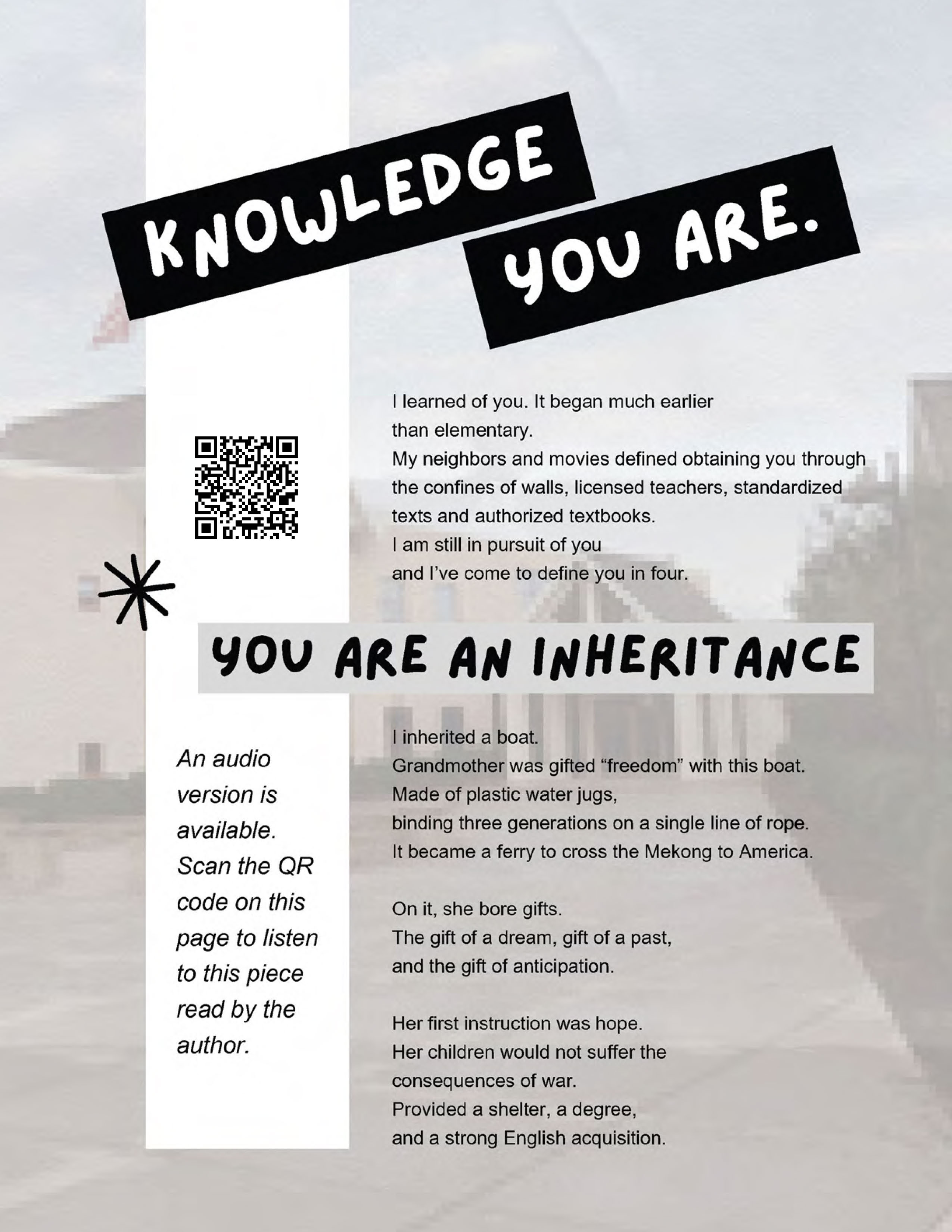 Behind the text, there is an image of a blurry elementary school front entrance. Text reads: Knowledge, You Are. I learned of you. It began much earlier than elementary. My neighbors and movies defined obtaining you through the confines of walls, licensed teachers, standardized texts and authorized textbooks. I am still in pursuit of you and I’ve come to define you in four. You are an inheritance. I inherited a boat. Grandmother was gifted “freedom” with this boat. Made of plastic water jugs, binding three generations on a single line of rope. It became a ferry to cross the Mekong to America. On it, she bore gifts. The gift of a dream, gift of a past, and the gift of anticipation. Her first instruction was hope. Her children would not suffer the consequences of war. Provided a shelter, a degree, and a strong English acquisition.
 -
 On the left side of the page, there is an image of a blurry elementary school building with an American flag raised. The following text is on the right side of the page: It became my prosperous objective to pull them ashore to a land of riches. Born an American, and taught English foremost, I began my homework. I set foot in kindergarten, Ambitious. Until I was pulled out of class because of my name, Enrolled in English Secondary Language (ESL). An hour from mathematics An hour from history Or an hour from reading time Compromised, to prove literacy in a language I knew first. When I was marked as a “non-native”, that shore felt like nothing but a mirage. I learned, Some children carry baggage larger than others. No matter what I knew, I would have to sit in that class For five years, and attempt to catch up on specialities beyond English. I carried baggage of silver customs, tossed aboard, to make anew. Coming empty-handed is unwelcome. Coming from empty-handed people, Was plain idiocy.
 -
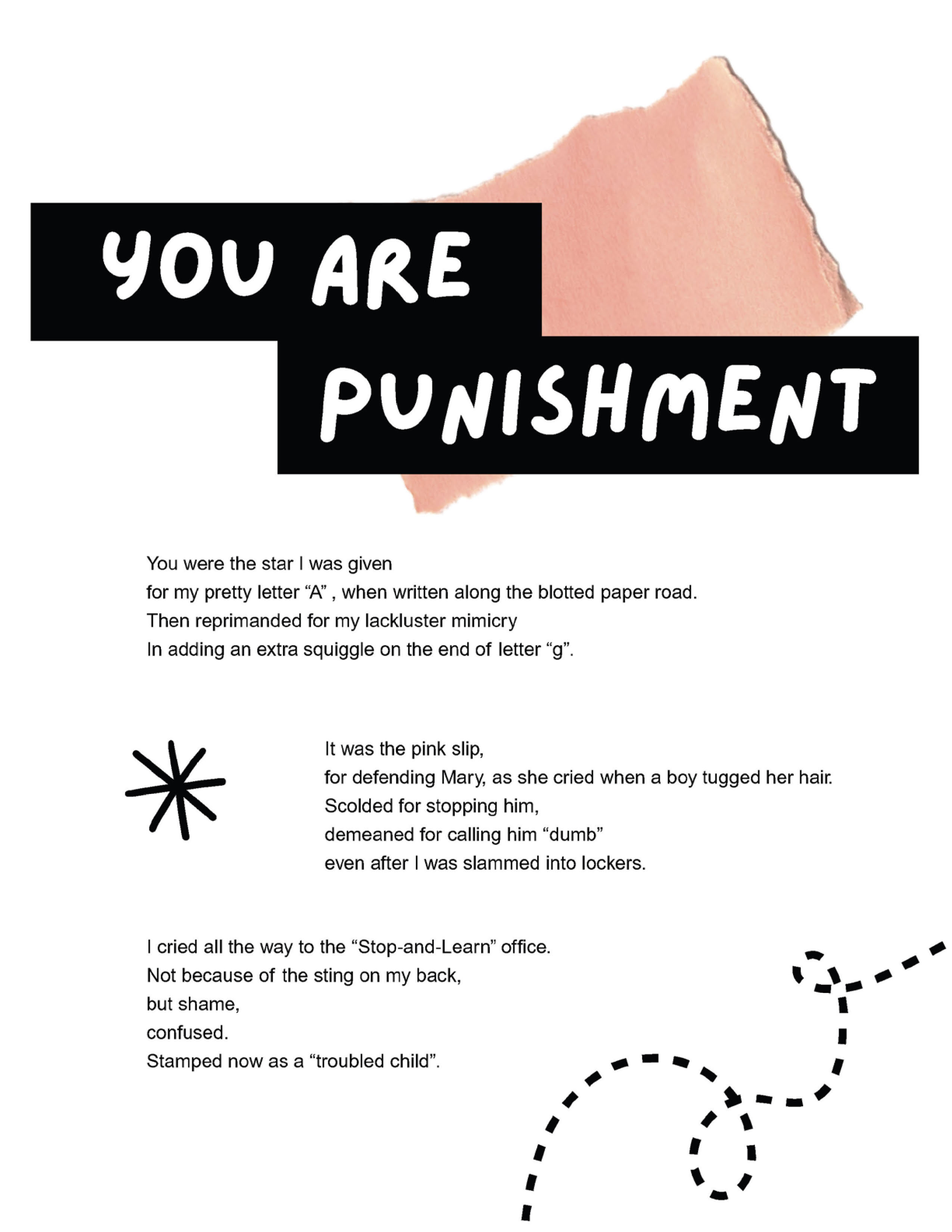 Underneath the title “You are Punishment” is a pink, torn sheet of paper. A dotted line with two swirls on the bottom right corner. Text reads as follows: You are punishment. You were the star I was given for my pretty letter “A” , when written along the blotted paper road. Then reprimanded for my lackluster mimicry In adding an extra squiggle on the end of letter “g”. It was the pink slip For defending Mary, as she cried when a boy tugged her hair. Scolded for stopping him, demeaned for calling him “dumb” even after I was slammed into lockers. I cried all the way to the “Stop-and-Learn” office. Not because of the sting on my back, but shame, confused. Stamped now as a “troubled child”.
 -
 The paper overlaps an oval-shaped photograph of a young child in a pair of pink pants and a yellow top. The face of the child is covered by the text “As a little, pretty, yellow-faced girl”. The following text is overlaid on the image: a little, pretty, yellow-faced girl, I learned to silence my “foul mouth”. Hold those contradictions in until I could scream them out through my little-pet-shop dolls. Little, pretty, yellow-faced girls must never “rock the boat”. I am now a stellar student.
 -
 Collage of images on a white background which includes a series of iridescent star stickers and a single larger, glittery yellow star. Text reads: I hold my piss during lecture. Disturbances for your bodily needs are an inconvenience to the classroom. I perform “accentless” for a request of cartoned milk. Lunch ladies should not be troubled to guess your request. I allow hall monitors to chastise me As walking outside of class to grab a pencil Is inexcusable. It is my job, to find the rules I defied And appease their might. Had I forgotten my disobedience, It came as a gushing reminder. During my elementary graduation, as my friends lined up in assembly awarded for “no-pink slips”, It was dumbfounding looks That I was not on that stage too. I conditioned years to become the “star-student”, as I sat in the row of troublemakers. Secondary school would be a repeat. of untestified obedience. I learned No matter who I believed I was, Who I defied to be, The world would only See me as a little, pretty, yellow-faced girl.
 -
 Black page with a single yellow, glittery star sticker. You are an infrastructure. Bubbling in twenty years is a fury. Fury are the waves jostling the boat. The boat, my body, slowly rotting the wood hold decades without repair. I was rotting, in a silent fury. How then, do you teach a person to speak again? Perhaps my makeshift attempt to amend All the discipline was living vicariously through poems pictures and books, who could “name” this pain. Novels from bell hooks and Ocean Vuong gave clarity to my bitterness. My pains are not solitary, but a force tethering our painful conditions to something we cannot see. The structures I found myself folding under are a net, set to capture, consume, then release damaged. It is an allusive guise. Hook to fish, desperate for food in a famished sea when it is those very hooks and nets that dried us out. When done, it disposes itself in us and suffocates all those who did not heed its call for capture.
 -
![Image of a cutout Statue of Liberty collage image underneath text. Three yellow glittery stars are sprinkled around the collaged image. Text reads: Knowledge, the one I speak as hegemonic Operates in schools, prisons, hospitals, and in our homes. Creates imbalance over those who differ from the dominant. “Defiance”, then, is a law to punish difference. It’s first lesson is my guilt. It taught me to abandon my own people. All to strive for the American Dream. [Neoliberalism’s erasure of the connections between the violences of the past and those of the present gives it its power.” ― Grace Hong] I think back to the dumbfounding looks. Their surprise. It is not that I rigorously constructed a persona of good, Before they saw me, they already saw me as “good”. With their presumptions from my name and face. The stories they tell of my heritage, And the future they already paved. A model minority. They take away stars, when I do not fit Their imagination of me. They imagine my home, though they never inquired. My inquiry then, is answered.](https://sparkezine.com/wp-content/uploads/2025/05/Knowledge-You-Are_Page_07.jpg) Image of a cutout Statue of Liberty collage image underneath text. Three yellow glittery stars are sprinkled around the collaged image. Text reads: Knowledge, the one I speak as hegemonic Operates in schools, prisons, hospitals, and in our homes. Creates imbalance over those who differ from the dominant. “Defiance”, then, is a law to punish difference. It’s first lesson is my guilt. It taught me to abandon my own people. All to strive for the American Dream. [Neoliberalism’s erasure of the connections between the violences of the past and those of the present gives it its power.” ― Grace Hong] I think back to the dumbfounding looks. Their surprise. It is not that I rigorously constructed a persona of good, Before they saw me, they already saw me as “good”. With their presumptions from my name and face. The stories they tell of my heritage, And the future they already paved. A model minority. They take away stars, when I do not fit Their imagination of me. They imagine my home, though they never inquired. My inquiry then, is answered.
Image of a cutout Statue of Liberty collage image underneath text. Three yellow glittery stars are sprinkled around the collaged image. Text reads: Knowledge, the one I speak as hegemonic Operates in schools, prisons, hospitals, and in our homes. Creates imbalance over those who differ from the dominant. “Defiance”, then, is a law to punish difference. It’s first lesson is my guilt. It taught me to abandon my own people. All to strive for the American Dream. [Neoliberalism’s erasure of the connections between the violences of the past and those of the present gives it its power.” ― Grace Hong] I think back to the dumbfounding looks. Their surprise. It is not that I rigorously constructed a persona of good, Before they saw me, they already saw me as “good”. With their presumptions from my name and face. The stories they tell of my heritage, And the future they already paved. A model minority. They take away stars, when I do not fit Their imagination of me. They imagine my home, though they never inquired. My inquiry then, is answered. -
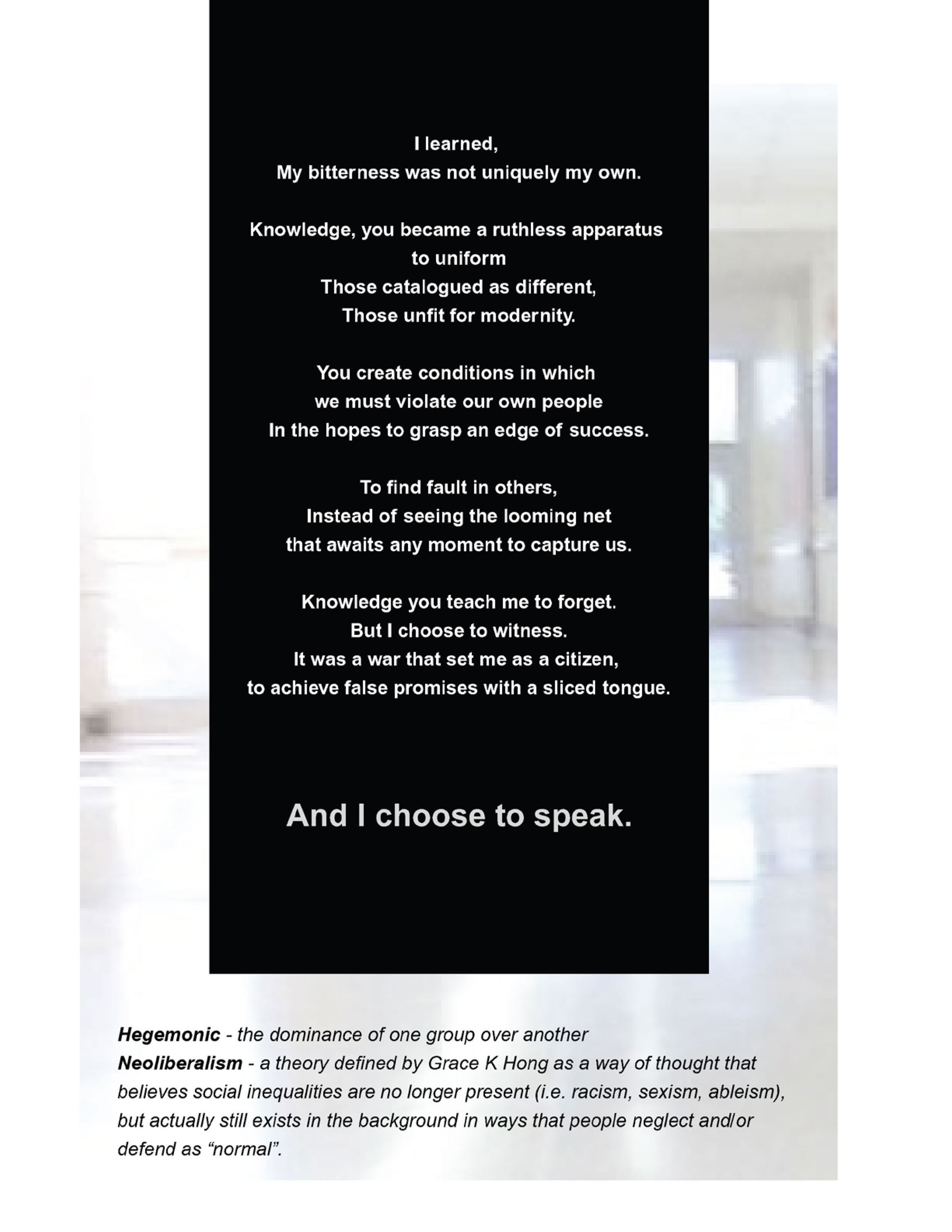 Under the black box and text is an oversaturated and transparent photograph of an elementary school hallway. There are doors in the photograph with a wall of different displayed student pieces. I learned, My bitterness was not uniquely my own. Knowledge, you became a ruthless apparatus to uniform Those catalogued as different, Those unfit for modernity. You create conditions in which we must violate our own people In the hopes to grasp an edge of success. To find fault in others, Instead of seeing the looming net that awaits any moment to capture us. Knowledge you teach me to forget. But I choose to witness. It was a war that set me as a citizen, to achieve false promises with a sliced tongue. And I choose to speak.
 -
![In the bottom right corner is the top half of a white, plastic jug. You are inflatable. In my attempts to speak, I write. And in my early graduate years, they say “you write so elementary”, I allow myself to drown, to wallow Wade through that comment and write again to stay afloat. Perhaps there is something to learn from elementary. Punished for starting with “I” and “but” But I don’t write only for academic approval. [“I am writing because they told me to never start a sentence with because. But I wasn't trying to make a sentence—I was trying to break free.” ― Ocean Vuong] In operating in the university, I understand My legitimacy is still bound to citational forms, method, and theory. But I remind myself, [“Knowledge is not for knowing: knowledge is for cutting.” ― Michel Foucault] [“To listen to and to tell a rush of stories is a method.” ― Anna Tsing] [“I saw in theory then a location for healing.” ― bell hooks] [“The personal is theoretical.” ― Sara Ahmed] Though they attempt to capture you Claim you as neutral, unbiased, fact. I can see you are ever moving. You are unruly, pooling with excess, spilling over And precariously parched. Like bodies of water, you rely on earth and oxygen You rely on the nourishment from those who witness you as more than a Single, undeniable truth or an imperial force. You are polysemic And you, a bitter taste on my tongue, can become Nourishment. As a teacher now, I break away those boundaries. Reminding myself, [“The classroom remains the most radical space of possibility in the academy.” ― bell hooks] As a human, bearing inheritances both of care and brutality, [“Let no one mistake us for the fruit of violence—but that violence, having passed through the fruit, failed to spoil it.” ― Ocean Vuong]](https://sparkezine.com/wp-content/uploads/2025/05/Knowledge-You-Are_Page_09.jpg) In the bottom right corner is the top half of a white, plastic jug. You are inflatable. In my attempts to speak, I write. And in my early graduate years, they say “you write so elementary”, I allow myself to drown, to wallow Wade through that comment and write again to stay afloat. Perhaps there is something to learn from elementary. Punished for starting with “I” and “but” But I don’t write only for academic approval. [“I am writing because they told me to never start a sentence with because. But I wasn't trying to make a sentence—I was trying to break free.” ― Ocean Vuong] In operating in the university, I understand My legitimacy is still bound to citational forms, method, and theory. But I remind myself, [“Knowledge is not for knowing: knowledge is for cutting.” ― Michel Foucault] [“To listen to and to tell a rush of stories is a method.” ― Anna Tsing] [“I saw in theory then a location for healing.” ― bell hooks] [“The personal is theoretical.” ― Sara Ahmed] Though they attempt to capture you Claim you as neutral, unbiased, fact. I can see you are ever moving. You are unruly, pooling with excess, spilling over And precariously parched. Like bodies of water, you rely on earth and oxygen You rely on the nourishment from those who witness you as more than a Single, undeniable truth or an imperial force. You are polysemic And you, a bitter taste on my tongue, can become Nourishment. As a teacher now, I break away those boundaries. Reminding myself, [“The classroom remains the most radical space of possibility in the academy.” ― bell hooks] As a human, bearing inheritances both of care and brutality, [“Let no one mistake us for the fruit of violence—but that violence, having passed through the fruit, failed to spoil it.” ― Ocean Vuong]
In the bottom right corner is the top half of a white, plastic jug. You are inflatable. In my attempts to speak, I write. And in my early graduate years, they say “you write so elementary”, I allow myself to drown, to wallow Wade through that comment and write again to stay afloat. Perhaps there is something to learn from elementary. Punished for starting with “I” and “but” But I don’t write only for academic approval. [“I am writing because they told me to never start a sentence with because. But I wasn't trying to make a sentence—I was trying to break free.” ― Ocean Vuong] In operating in the university, I understand My legitimacy is still bound to citational forms, method, and theory. But I remind myself, [“Knowledge is not for knowing: knowledge is for cutting.” ― Michel Foucault] [“To listen to and to tell a rush of stories is a method.” ― Anna Tsing] [“I saw in theory then a location for healing.” ― bell hooks] [“The personal is theoretical.” ― Sara Ahmed] Though they attempt to capture you Claim you as neutral, unbiased, fact. I can see you are ever moving. You are unruly, pooling with excess, spilling over And precariously parched. Like bodies of water, you rely on earth and oxygen You rely on the nourishment from those who witness you as more than a Single, undeniable truth or an imperial force. You are polysemic And you, a bitter taste on my tongue, can become Nourishment. As a teacher now, I break away those boundaries. Reminding myself, [“The classroom remains the most radical space of possibility in the academy.” ― bell hooks] As a human, bearing inheritances both of care and brutality, [“Let no one mistake us for the fruit of violence—but that violence, having passed through the fruit, failed to spoil it.” ― Ocean Vuong] -
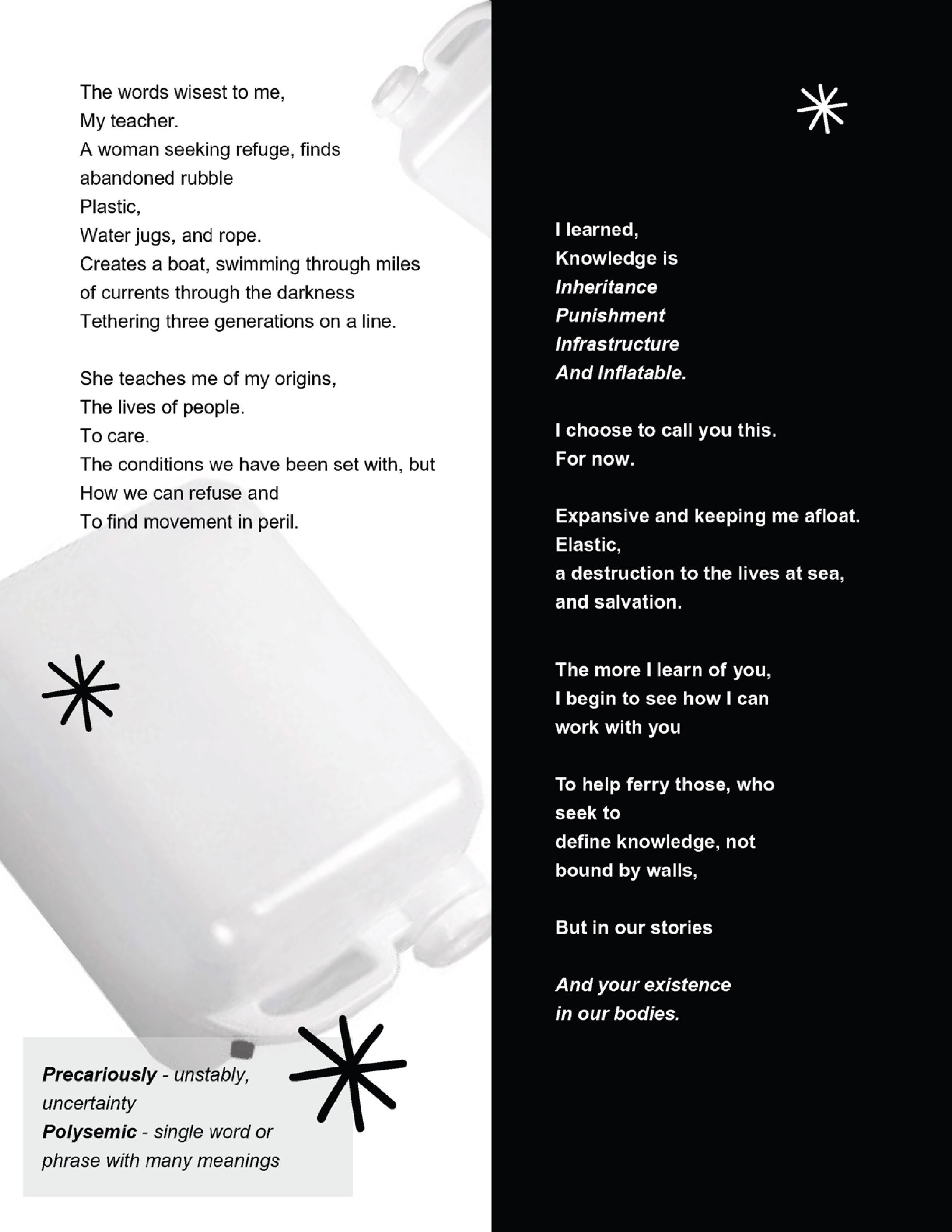 In the center and upper right top side of the page are two plastic, white water jugs. Text reads: The words wisest to me, My teacher. A woman seeking refuge, finds abandoned rubble Plastic, Water jugs, and rope. Creates a boat, swimming through miles of currents through the darkness Tethering three generations on a line. She teaches me of my origins, The lives of people. To care. The conditions we have been set with, but How we can refuse and To find movement in peril. I learned, Knowledge is Inheritance Punishment Infrastructure And Inflatable. I choose to call you this. For now. Expansive and keeping me afloat. Elastic, a destruction to the lives at sea, and salvation. The more I learn of you, I begin to see how I can work with you To help ferry those, who seek to define knowledge, not bound by walls, But in our stories And your existence in our bodies.
 -
 Two simple black doodles of a star are at the lower left hand corner of page and the upper right corner of page. Author’s Words: First, thank you for being an audience for my piece – “Knowledge You Are”. I start with sharing that I am a third generation Hmong artist. While my parents spoke English and achieved an associates degree, they still did not achieve the “American Dream”, and so it fell onto my shoulders to continue this generational mission. My parents worked tirelessly to make ends meet, so my grandmother raised me during my early childhood. She taught me Hmong, classic fables, and many life lessons. Out of the thousands of pages I read in graduate school, she continues to be my most reputable philosopher and teacher. I wrote this out of hurt. And I was hurting – a lot. Bitter is my favorite word to describe my years in the American education system. I dedicated years of my self-worth in achieving “knowledge”. I was jealous when my friends went into the advanced English classes. I was anxious during my assessments, afraid of being “behind”. And I felt lost when I finally reached “perfection”, then had to unlearn it all. I always faulted myself for not knowing enough, particularly the rules (even though they are socially constructed, biased, and ever-changing). I found being an American citizen and fluent in English, isolated me as I would never be "American" enough. When I compromised Hmong acquisition for English, I realized my efforts were in vain — I would never be "Hmong" enough now either. But, I’ve begun to find my voice again, even if it is in the language I grew to despise. This piece is a way to illustrate how “knowledge” is a fluid definition for me. I retraced my most painful memories in hopes that you, the audience, who share similar reflections can see that pain is the failure of a system. This system neglects our histories, punishes our difference, and attempts to make us uniform to the hegemonic. When we face this violence, it attempts to destroy our coalition in divisive ways. It makes us battle each other to determine whose pain is worse than another and teaches us to abandon our people. I believe that listening is one of the many acts to combat these injustices. In hopes of minimizing the same academic violence I endured, I bolded jargony words to make this piece accessible. I often felt stupid when a big word or names of an author I didn’t know were dropped. Unfortunately, I find sometimes the best words to describe my ideas are the big words. I also sprinkle quotes from my favorite authors, artists, and thinkers across the disciplines of humanities. This is a way to showcase my knowledge as an intimate conversation with these activists and philosophers. These thinkers, many being endarkened feminist epistemologists, became my solace in naming the bitterness.
 -
 One simple black doodle of a star on the upper right corner of the page. I grew to value books again and think back to Toni Morrison, as she calls books “a form of political action. Books are knowledge. Books are reflections. Books change your mind.” They’ve greatly informed my research and my own way of life. Aside from published books, the most valuable teachers are my intellectual graduate friends and our robust conversations on the academy. You have tenderly cared for me, so much so, that I have found the confidence to speak again. I’d like to send you off with another tidbit of knowledge from Angela Davis, a Black American feminist activist and thinker: “Our histories never unfold in isolation. We cannot truly tell what we consider to be our own histories without knowing the other stories. And often we discover that those other stories are actually our own stories.” Reader, I encourage you to seek your own stories, along with those around you. From humans, the rocks and streams, and from places of banality. In valuing what they are saying, we can continue amending the pains to create a nourishing future. I, too, hope to see you speak of knowledge in the future. Thank you. Definitions of Bolded Words Hegemonic - the dominance of one group over another Neoliberalism - a theory defined by Grace K Hong as a way of thought that believes social inequalities are no longer present (i.e. racism, sexism, ableism), but actually still exists in the background in ways that people neglect and/or defend as “normal”. Polysemic - single word or phrase with many meanings Precariously - unstably, uncertainly Humanities - study of humans and disciplines including literature, art, history, and philosophy Epistemologists - people studying knowledge Banality - the day to day, normality References Ahmed, S. (2017). Living a feminist life. Duke University Press. Davis, A. Y., West, C., & Barat, F. (2016). Freedom Is a Constant Struggle: Ferguson, Palestine, and the Foundations of a Movement (1st ed.). Haymarket Books. Dillard, C. B. (2000). The substance of things hoped for, the evidence of things not seen: Examining an endarkened feminist epistemology in educational research and leadership. International Journal of Qualitative Studies in Education, 13(6), 661–681. https://doi-org.ezp3.lib.umn.edu/10.1080/09518390050211565 Foucault, M. & Rabinow, P. (1984). The Foucault reader: An introduction to Foucault’s thought, with major new unpublished material (1st ed.). Pantheon Books. Hong, G. K. (2015). Death beyond disavowal : the impossible politics of difference. University of Minnesota Press. hooks, b. (1994). Teaching to transgress : education as the practice of freedom. Routledge. Lorde, A. (1984). Sister outsider: essays and speeches. Crossing Press. Lorde, A. (2018). The master’s tools will never dismantle the master’s house. In Penguin Modern series (Vol. 23). Penguin Books. Morrison, T. (1994). Lecture and speech of acceptance upon the award of the Nobel Prize for literature : delivered in Stockholm on the seventh of December, nineteen hundred and ninety-three (1st ed.). A.A. Knopf. Vuong, O. (2019). On Earth we’re briefly gorgeous : a novel. Penguin Press.
Listen
Listen to an audio version of the poems in “Knowledge You Are” read aloud by the author.
Plain Text
Author’s Word
First, thank you for being an audience for my piece – “Knowledge You Are”.
I start with sharing that I am a third generation Hmong artist. While my parents spoke English and achieved an associates degree, they still did not achieve the “American Dream”, and so it fell onto my shoulders to continue this generational mission. My parents worked tirelessly to make ends meet, so my grandmother raised me during my early childhood. She taught me Hmong, classic fables, and many life lessons. Out of the thousands of pages I read in graduate school, she continues to be my most reputable philosopher and teacher.
I wrote this out of hurt. And I was hurting – a lot. Bitter is my favorite word to describe my years in the American education system. I dedicated years of my self-worth in achieving “knowledge”. I was jealous when my friends went into the advanced English classes. I was anxious during my assessments, afraid of being “behind”. And I felt lost when I finally reached “perfection”, then had to unlearn it all. I always faulted myself for not knowing enough, particularly the rules (even though they are socially constructed, biased, and ever-changing). I found being an American citizen and fluent in English, isolated me as I would never be “American” enough. When I compromised Hmong acquisition for English, I realized my efforts were in vain — I would never be “Hmong” enough now either. But, I’ve begun to find my voice again, even if it is in the language I grew to despise.
This piece is a way to illustrate how “knowledge” is a fluid definition for me. I retraced my most painful memories in hopes that you, the audience, who share similar reflections can see that pain is the failure of a system. This system neglects our histories, punishes our difference, and attempts to make us uniform to the hegemonic. When we face this violence, it attempts to destroy our coalition in divisive ways. It makes us battle each other to determine whose pain is worse than another and teaches us to abandon our people. I believe that listening is one of the many acts to combat these injustices.
In hopes of minimizing the same academic violence I endured, I bolded jargony words to make this piece accessible. I often felt stupid when a big word or names of an author I didn’t know were dropped. Unfortunately, I find sometimes the best words to describe my ideas are the big words. I also sprinkle quotes from my favorite authors, artists, and thinkers across the disciplines of humanities. This is a way to showcase my knowledge as an intimate conversation with these activists and philosophers. These thinkers, many being endarkened feminist epistemologists, became my solace in naming the bitterness.
I grew to value books again and think back to Toni Morrison, as she calls books “a form of political action. Books are knowledge. Books are reflections. Books change your mind.” They’ve greatly informed my research and my own way of life. Aside from published books, the most valuable teachers are my intellectual graduate friends and our robust conversations on the academy. You have tenderly cared for me, so much so, that I have found the confidence to speak again.
I’d like to send you off with another tidbit of knowledge from Angela Davis, a Black American feminist activist and thinker: “Our histories never unfold in isolation. We cannot truly tell what we consider to be our own histories without knowing the other stories. And often we discover that those other stories are actually our own stories.”
Reader, I encourage you to seek your own stories, along with those around you. From humans, the rocks and streams, and from places of banality. In valuing what they are saying, we can continue amending the pains to create a nourishing future.
I, too, hope to see you speak of knowledge in the future.
Thank you.
Definitions of Bolded Words
- Hegemonic – the dominance of one group over another
- Neoliberalism – a theory defined by Grace K Hong as a way of thought that believes social inequalities are no longer present (i.e. racism, sexism, ableism), but actually still exists in the background in ways that people neglect and/or defend as “normal”.
- Polysemic – single word or phrase with many meanings
- Precariously – unstably, uncertainly
- Humanities – study of humans and disciplines including literature, art, history, and philosophy
- Epistemologists – people studying knowledge
- Banality – the day to day, normality
References
Ahmed, S. (2017). Living a feminist life. Duke University Press.
Davis, A. Y., West, C., & Barat, F. (2016). Freedom Is a Constant Struggle: Ferguson, Palestine, and the Foundations of a Movement (1st ed.). Haymarket Books.
Dillard, C. B. (2000). The substance of things hoped for, the evidence of things not seen: Examining an endarkened feminist epistemology in educational research and leadership. International Journal of Qualitative Studies in Education, 13(6), 661–681. https://doi-org.ezp3.lib.umn.edu/10.1080/09518390050211565
Foucault, M. & Rabinow, P. (1984). The Foucault reader: An introduction to Foucault’s thought, with major new unpublished material (1st ed.). Pantheon Books.
Hong, G. K. (2015). Death beyond disavowal : the impossible politics of difference. University of Minnesota Press.
hooks, b. (1994). Teaching to transgress : education as the practice of freedom. Routledge.
Lorde, A. (1984). Sister outsider: essays and speeches. Crossing Press.
Lorde, A. (2018). The master’s tools will never dismantle the master’s house. In Penguin Modern series (Vol. 23). Penguin Books.
Morrison, T. (1994). Lecture and speech of acceptance upon the award of the Nobel Prize for literature : delivered in Stockholm on the seventh of December, nineteen hundred and ninety-three (1st ed.). A.A. Knopf.
Vuong, O. (2019). On Earth we’re briefly gorgeous : a novel. Penguin Press.