


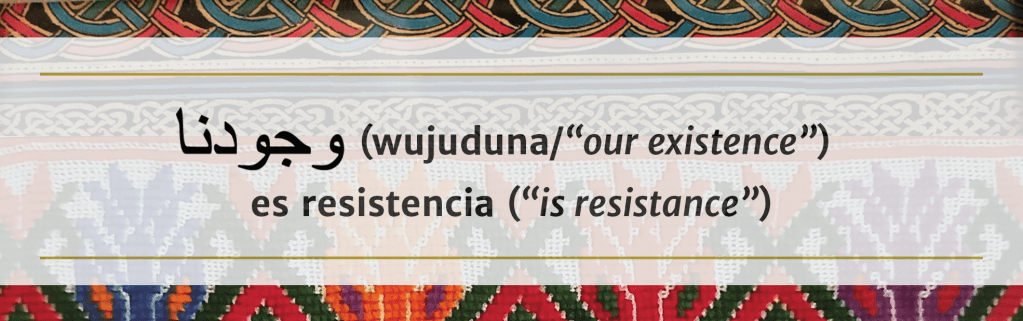
As first- and second-generation immigrant women in a Ph.D. program, we grapple daily with questions of belonging: Should we be here? Is this the right place to advocate for our communities? Confronted with the ongoing genocide in Palestine (United Nations 2024), the erosion of immigrant rights, and the institutional erasure of identity (National Immigrant Justice Center 2025), community becomes more than just a personal bond but a site of resistance. Here we explore: How has community transformed our ability to nourish ourselves, our cultures, and movements for liberation? How do we nurture radical hope and love not as individuals, but collectively–through the relationships we build, the histories we recover, and the commitments we make to one another?
We–Xochitl, a Mexican immigrant committed to cultivating spaces of belonging, and Isabella, a second-generation Pakistani immigrant passionate about advocating for a world without borders and prisons–are two friends with the same birthday whose cultural roots are oceans apart. Yet, we found ourselves sharing a common urban geography, drawn together by a commitment to activist scholarship. We offer an ode to community, highlighting stories as examples of where we have learned to (re)claim our histories, honor our ancestors, and embrace joy.
Weaving together poetry and lived experiences, we reflect on how building community serves as a foundation for embodying a radical imagination as a fueling source to persevere and thrive. Our experiences in community demonstrate how differences in culture, identity, and epistemology are not obstacles but catalysts for deeper understanding and collective growth.
(Re)Claiming as Political and Personal Resistance
i am a culmination of ancestral embraces of love and courage
As women who have been shaped by migration histories of displacement, border violence (“herida abierta1”), and state surveillance, we have witnessed how policies of exclusion attempt to separate families and the relationships that sustain collective resistance. Though in the face of these attacks, our connection to our families and friends has allowed us to embrace our cultures with pride.
Isabella:
The post-9/11 world tried to sever our ties as fear of anti-Muslim violence kept many, including my family, from practicing language and faith, but we found ways to hold our loved ones closer.
It is 10:00 PM PST and my father comes home with a stack of calling cards, each one a fleeting bridge to family in Pakistan. Tonight, the call is about my grandfather’s health and immigration visa. Being so young, I wait to say سلام (salaam/“hello”) to my grandpa after my parents finish talking. We speak in a mix of broken Urdu and English, held together with prayers.
“One minute left’, the automated voice cuttingly warns.
“May الله (Allah) guide you”, my grandfather says.
Ten seconds left: میں آپ کے لیے دعاکرتی ہوں (“I pray for you”).
“I love y—” the call drops.
While brief, these calls gave me strength. Learning language as I’ve gotten older has been an act of defiance against the forced forgetting that assimilation demands and is my way to reclaim history, identity, and connection.
in the dream i am back home & i am beautiful my country
wrapped like an embrace around me my god not hated
my language washed of all its hesitation
― Safia ElHillo, Excerpt from “Another Life”

Xochitl:
After an exhausting day of class, Isabella is driving me home. As we approach the stop sign before my place, Isabella asks for an example of when I had to reclaim my culture. Immediately, I think about my first name and my relationship with it. I share with her about my middle name, Yaneth (phonetic: YAH-net), and how I went by “Janet” (phonetic: Jahn-it). Jahn-it was not as my father intended it to be pronounced. Jahn-it was the name of survival during a time in my life when I was wrestling with existing in the in-between. Jahn-it represented my search for belonging. As I shared my name journey with Isabella, I saw myself reflected. Isabella knew what it meant to exist in the in-between. As I was about to get out, Isabella said, “You will always be Xochitl.”
Community is a form of nourishment, a radical refusal to succumb to isolation and despair. It is a place providing refuge when institutions, such as academia and the state, dehumanize and exclude us. Living in the U.S. and attending predominantly white institutions, we were expected to accept mispronunciations of our names, shrinking ourselves, all to assimilate into white spaces where we questioned whether we belonged at all.
We are not fractured identities, but inheritors of vast and powerful lineages. We refuse to sever ourselves from our ancestors, from the knowledge they have passed down, and from the histories and traditions that live in our blood.
We came to embody our full identities through organizing–Xochitl in working as a legal representative for migrant survivors of gender-based violence, and Isabella with being part of Ethnic Studies coalitions and free legal clinics for people seeking asylum. We now work together to facilitate “Know Your Rights” trainings and mutual aid initiatives for our community. We are not just fighting for policy change; we are fighting for our collective survival and belonging. We have become whole over time, slowly taking shape into our full selves.
In the spaces where our backgrounds are flattened, we become roses growing out of concrete, reclaiming a new way of hope (Duncan-Andrade 2009). We resist so that we may exist fully through our everyday actions of
(re)claiming ourselves.
“The paper here wilts in my hands
it is so light. My motherland
creaks underneath it. I try to be patient
like my mother. I sit and wait
for the world to take care
of itself, but it calls out for me.”
–Jeevika Verma, Excerpt from “Clinical”

Tu Lucha es mi Lucha2 / التحرير قريب 3
Our survival is an act of love
Acknowledging how our histories are interconnected helps us build power to create stronger communities in a society seeking to erase us. Through organizing, we express a commitment to the wisdom of our cultures that teaches us resistance is not new, nor is the solidarity that sustains it. “Quisieron enterrarnos, pero no sabían que éramos semillas,4” became a popular protest chant after the disappearance of 43 students from Ayotzinapa, Mexico in 2014. This slogan calls out that we are resilient and that any attempt to oppress our existence will only plant the seeds for future resistance. Islam also reminds us that we are like bricks who strengthen one another, that justice is a collective duty, and that the أُمَّة (Ummah5) is bound by care, not by borders. Such teachings demonstrate that repression will never subvert collective struggle.
We understand our liberation is about dismantling systems of domination that affect us in different yet deeply linked ways. We share languages, Arabic and Spanish, to stay rooted in who we are and empathize with one another’s struggles. At events demanding an end to the occupation of Palestine, Isabella translates and describes what calls for decolonization mean and look like (من المية للمية/Min il-maya lal maya/“From the river to the sea,” Palestine will be free) so we can chant together. We share stories of our histories and draw connections, attending concerts where Ana Tijioux, a French-born Chilean musician, calls for international solidarity (“No te tenemos miedo, tenemos vida y fuego”6). Together, we echo their demands for liberation.
Friendships represent a bridge that is built on the love and knowledge we inherit and share, where solidarity is not just possible but inevitable.
In co-authoring this piece, we’ve reflected on the ways we have felt cared for in our own friendships and how solidarity is a lived practice.
Hay tantísimas fronteras
que dividen a la gente,
pero por cada frontera
existe también un puente7
–Gina Valdés
Community as a Site of Solidarity and Care
Standing with my Ummah / mi gente is how i heal
In a society built to isolate and dispossess, we have a duty to show up for one another. Solidarity is ultimately about action. It means standing beside each other in grief, fear, and uncertainty, offering support that reflects a commitment to one another’s safety and well-being. We have both felt solidarity in practice from our various friends who have held us, understood us, and have reminded us that love and resistance are inseparable.

Isabella:
When a friend from graduate school told me that her family’s neighborhood in Lebanon was bombed by israeli occupation forces, she pulled up a map, tracing her childhood home then three doors down to a house now only rubble. She showed me WhatsApp messages filled with shattered windows and broken streets, mourning the place where she learned to ride a bike.
Days later, her department chair sent an email with the subject line “war” and a single sentence: “I hope you’re doing alright with all that’s going on.” Where was the real support—for her loss, for her family’s survival? How could it exist when the very institutions we attend invest in the bombs that murder Palestinian and Lebanese families? (Dernbach and Goffaux 2024; Navratil 2024; Premo et al. 2024).
We sat together, keffiyehs draped around our necks, lamenting the surveillance of our holy sites, the criminalization of protests, and the weight of knowing that speaking out makes us targets. Grief and rage blurred into one, but neither of us had to explain or soften our emotions for one another. Friendship became a sanctuary where we could attend protests and talk with care about how to support our people.
¿Podemos escucharnos una a otra? / هل يمكنك فهمي؟
To lean on a friend is to know and hold a precious space where we replenish ourselves. As we both share examples of leaning on friends for support, we share how collective care is an essential part of friendships. Caring for one another allows us to learn and grow in community as we uplift and show up.

Xochitl:
As the snow melted in the spring of 2010, Arizona had passed the “show me your paper” law, SB 1070. As our campus went on without discussing the xenophobic law, my friend and I found ourselves in shock. We both come from migrant families, she grew up being able to see the border from her backyard. We were attending college in what felt like the middle of nowhere. The small town where our college was located is known for being conservative, yet it had a significantly diverse migrant community. Our college careers had just begun, and we were confronted with laws seeking to target our community. Uncertain who we could lean on and what to do, we decided to join the national calls for boycotting Arizona Tea8. It was our first collective act of resistance as friends. As the spring blossomed, so did our beginning praxis of resistance and solidarity.
Radical Hope and Love
i exist with joy and gratitude
Community as different sites of resistance and solidarity is not a new concept. Within our field of sociology, scholars have discussed the importance of friendship beyond just another personal relationship (Allan and Adams 2006). Instead, they point to the significance of friendship as a place where solidarity is cultivated. It remains crucial to underscore the value of friendships, especially in times of turmoil. Through our friendship, we have been able to share moments of vulnerability, carving spaces to be seen, to be heard, and to be reminded that a pause is needed.
We maintain radical hope by “bear[ing] witness to what our bodies remember and what el corazón con razón [the heart with reason] experiences” (Anzaldúa 2012:21). In holding one another, we can dive into ourselves to recall how respective experiences have manifested both physically and internally.
We heal with the sounds of joy. Through humor and loud laughs transcending walls, we have been able to reduce our stress and reconnect to our bodies in a way that invites light in moments of darkness. As we sit on the ancient chairs in our shared office, we laugh loudly as we close the door so that our joy will not be silenced. Laughter has consoled us, and joy gives us the energy to have love and hope.
“Rarely, if ever, are any of us healed in isolation. Healing is an act of communion.”
–bell hooks

Isabella:
On our birthday in 2024, Xochitl and I introduced our moms as they were both visiting Minneapolis. Despite the language barriers, we belly-laughed and shared stories. Months later, my mom was diagnosed with breast cancer. Xochitl was immediately there to support me, sharing healing thoughts from her mom to mine. Xochitl invited me out to what was meant to be a lunch and turned into a day of running errands. While giving space for me to share about the next steps for my mom’s treatment, she also made sure to make me smile, telling me stories about her cousins and playing her new favorite songs. Xochitl helped me find joy and tenderness in a moment where that otherwise felt impossible.
Conclusion
I am whole because of the mosaic of people who love and care about me
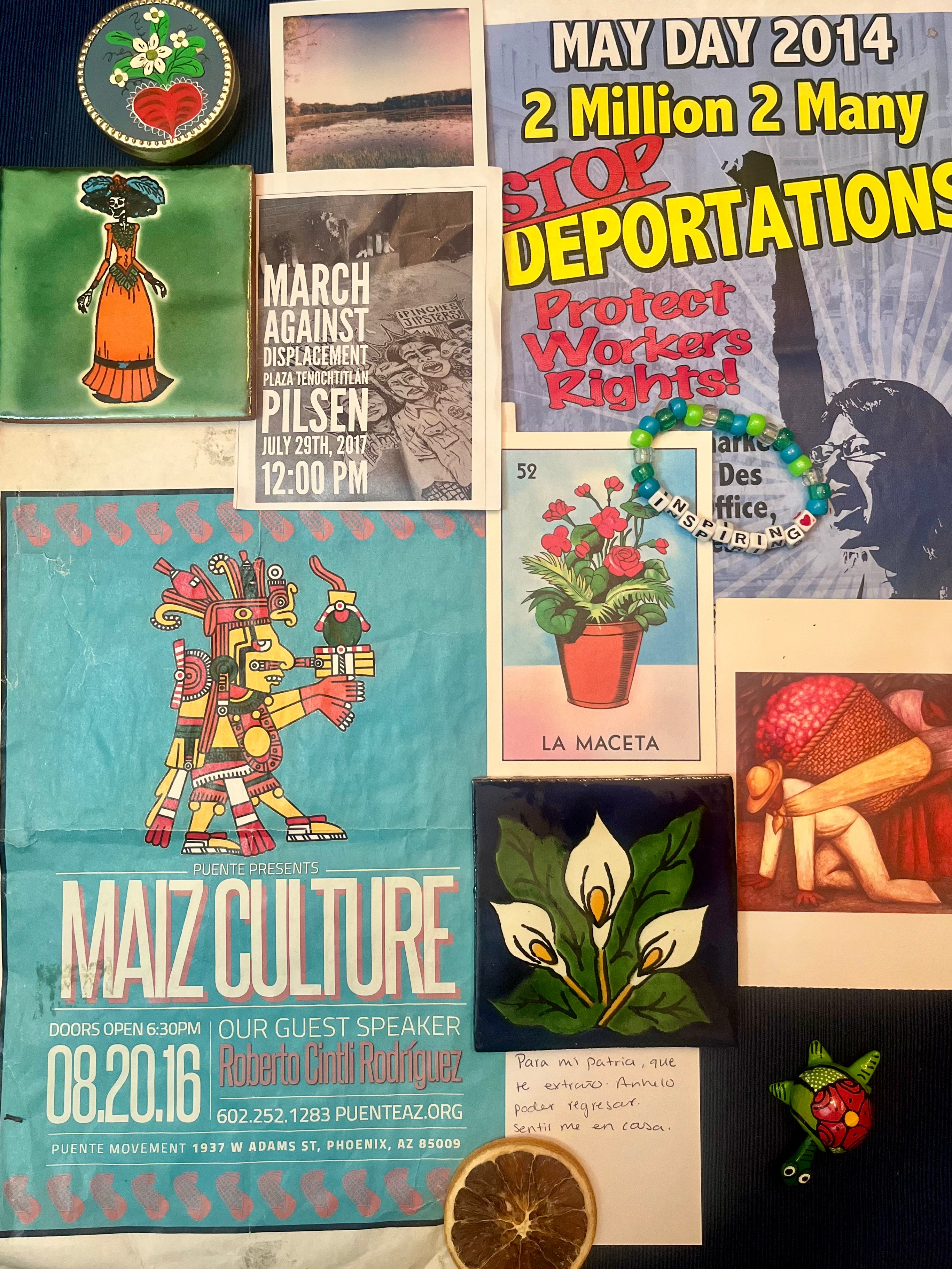
We dedicate this piece to the power of community, to the site where we can lean on, learn, and grow with one another. Our cultures are a living force – an ever-unfolding story of resistance, love, and courage. We exist fully, unapologetically, in honor of those who came before us and those who will come after.
We hope that through sharing our lessons of community, others reflect on their own respective histories and contemplate the memories and adventures treasured. Our communities and friendships are robust chosen relationships composed of care, humor, hope, and love where we are honored to cultivate a better tomorrow.
“To love. To be loved. To never forget your own insignificance. To never get used to the unspeakable violence and the vulgar disparity of life around you. To seek joy in the saddest places. To pursue beauty in its lair…Above all, to watch. To try and understand. To never look away. And never, never to forget.”
–Arundhati Roy
References
Allan, Graham and Rebecca G. Adams. 2006. “Sociology of Friendship” in Bryant, Clifton D. and Dennis L. Peck, The Handbook of 21st Century Sociology. Sage.
Anzaldúa, Gloria. 2012. Borderlands La Frontera: The New Mestiza. Aunt Lute Books.
Dernbach, Becky Z. and Elza Goffaux. 2024. “University of Minnesota rejects calls to divest from Israel; will limit protests to 100 people.” Sahan Journal.
Duncan-Andrade, Jefferely. 2009. “Note to Educators: Hope Required When Growing Roses in Concrete.” Harvard Educational Review 79(2):181-194.
Elhillo, Safia. 2021. Home Is Not a Country. Make Me a World.
hooks, bell. 1999. All About Love. HarperCollins Publishers.
National Immigrant Justice Center. 2025. “Leading with Cruelty: Eight Impacts of Trump’s First Day Executive Orders.” NIJC.
Navratil, Liz. 2024. “University of Minnesota spent about $1 million this school year on companies with ties to Israel.” The Star Tribune.
Premo, Cole, Beret Leone, and Pauleen Le. 2024. “U of M’s Board of Regents declines request to divest from companies supporting Israel.” CBS News.
Roy, Arundhati. 1999. The Cost of Living. Modern Library.
United Nations. 8 October 2024. “One-year of Israel’s genocide against the Palestinians – Letter from the State of Palestine – (A/ES-10/1012-S/2024/719).” (https://www.un.org/unispal/document/palestine-letter-08oct24/).
Verma, Jeevika. 2019. Poem “Clinical.” All Female Menu.
FootNotes
- From Borderlands La Frontera: The New Mestiza by Gloria Anzaldúa where she describes borders as “herida abierta” translated to: “open wounds” 3. ↩︎
- Translation: Your struggle is my struggle. ↩︎
- Translation: Liberation is close. ↩︎
- Translation: They tried to bury us but didn’t know we were seeds. ↩︎
- Ummah/أُمَّة means “community” in Arabic, which refers to Islamic holy community bound together in shared beliefs, morals, and ways of life; to some this has been expanded to mean humanity as family. ↩︎
- A line from Ana Tijoux’s song “Somos sur” featuring Shadia Mansour, from the album “Vengo” (2014) / Translation: We don’t have fear, we have life and fire. ↩︎
- Quote featured in Borderlands La Frontera: The New Mestiza by Gloria Anzaldúa in the chapter “La conciencia de la mestiza / Towards a New Consciousness,” 85. Poem translation: There are so many borders / that divide people, / but for every border / there is also a bridge ↩︎