


My pursuit of inclusive clothing design inspired me to submit an article to SPARK sharing my experiences. I am a person with a disability who researches collaborative clothing design, specifically with people who have disabilities. Meaning, I work alongside people with disabilities, research disability experiences, design from a disability perspective, and even live with disability. This position supports me to achieve the goal of embracing perspectives from marginalized communities in my research.
*Reader* That’s interesting. Tell me more.
As a person with a disability working alongside other people with disabilities, every day I learn to embrace the difference that exists within our communities. Conversations with fellow disability community members that I have met through social media and group forums, constantly remind me how diverse our experiences are despite living with similar impairments. Like, “What do you mean you don’t like wearing leather because of its rigidity?” or “Wow! So you really dislike the coarseness and bulkiness of denim? These are the exact reasons why I love these things!” These clothing preferences are our responses to encountering disability, yet they are opposites. This is one reason why I conduct participatory research with members of my community: it facilitates community engagement through documenting narratives from within our communities.
One principle I follow when engaging in this research is to ensure that everyone involved benefits from their participation.
Too many times I have read studies conducted by people who do not have a disability where the primary focus was data and what the results meant for science. With each project, I first look to determine how involving other disability community members may benefit them and larger disability communities. There is no reason why I, as a researcher, should be the only one benefiting from these projects when other community members are also contributors.
*Reader* Okay, okay, we get it, you put the people first. Well, now it’s time to prove it.
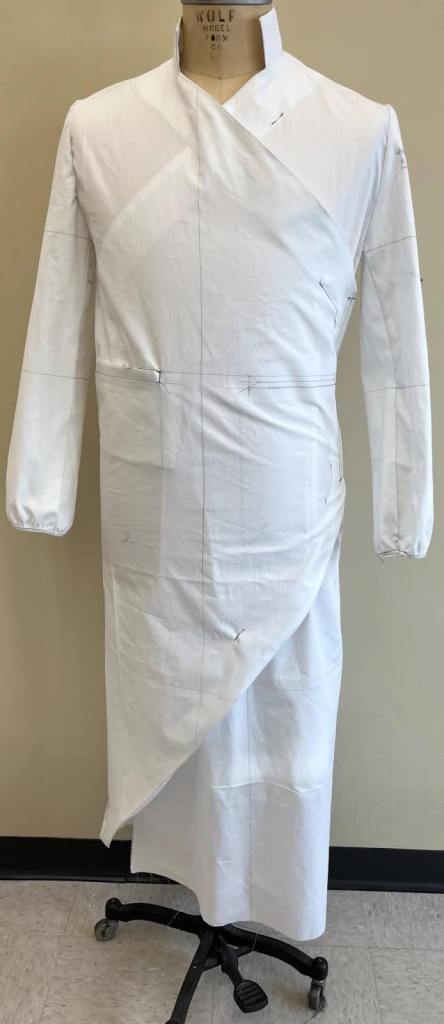
It is funny you say that, unnamed reader, because as part of my dissertation I am working alongside other people with disabilities to develop clothing that they believe will improve their well-being. I recruited these participants through disability organizations at the University of Minnesota. This collaborative design project took place over several months and involved frequent virtual and in-person meetings to discuss the kind of clothing they wanted to design, the types of fabric they liked, and ultimately what the article of clothing would look like (See Figure 1). This was important as collaborators were individuals who experience tactile sensory sensitivities.

This process also involved the sketching of potential design ideas and constructing garment samples for the community member to try and provide feedback to improve fit and style (see Figure 2 and Figure 3). These informal meetings informed every aspect of the designs. As collaborators shared their lived experiences with existing clothing options, I learned more about the impact that certain fabrics and styles of clothing had on their comfort in professional, social, and leisure settings.
My motivation for conducting participatory research is to address the clothing wants and needs of people with disabilities, which many of us across disability communities believe to be under-acknowledged. As a person with a disability, I am aware of the importance that clothing plays in our lives. Promoting the use of participatory design will grant disability community members control over the clothing being designed, shifting from designing for people with disabilities to designing with people with disabilities. Embracing community participation and engagement throughout my research ensures that featured community members have shared authority on the research involving their communities.

*Reader* Okay, well how would these clothes be any different from what can be purchased in stores?
My motivation for conducting participatory research led to another part of my dissertation, where I distributed a survey to people with disabilities who I have met through our mutual participation in disability group forums, to better understand their encounters with clothing related barriers. This study focused on identifying the potential relationship between experiencing tactile sensory sensitivities and encountering clothing challenges. Survey results from 20 people with disabilities who experience tactile sensory sensitivities revealed a strong association, as the majority of community members encountered clothing barriers that negatively impacted multiple aspects of their lives.
This study supported what I and other disability community members already knew, which is that many existing clothing options do not accommodate people with disabilities and that this lack of access to accommodating clothes can have negative impacts on our lives. Community member responses indicated that people with disabilities have completely different experiences with their clothing compared to people who do not have disabilities. This illustrates a textbook example of difference and why I am so interested in this type of research.
*Reader* Wow, I guess I never really thought about that. What else did you find out? Here’s the time to tell us what this “difference” means.
I am glad you asked, I can discuss this all day. The other focus of this study was to identify the specific clothing wants and needs that people experiencing tactile sensory sensitivities may have. Responses from 20 people experiencing tactile sensory sensitivities revealed what individuals in this disability community prefer to wear: clothes made from natural fibers like cotton and wool over clothes made from synthetic fibers like polyester and nylon; loose fitting clothes over regular and tight fitting clothes; and casual styles of clothing over athletic and formal styles of clothing.
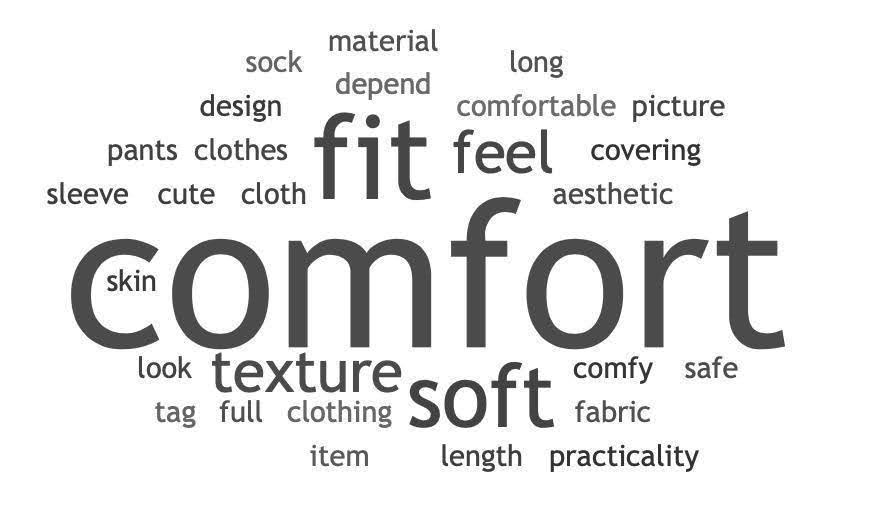
This study also provided me the opportunity to learn about the single most important thing that people experiencing tactile sensory sensitivities may look for in their clothing. Using a word cloud which visualizes participant responses with the most frequently used words appearing in larger text, I learned that we prioritize function, fibers, and fashion (see Figure 4).
*Reader* Ohh, okay, I understand now.
But wait, there’s more. Not only did I learn that people experiencing tactile sensory sensitivities have clothing wants and needs different from people who do not experience tactile sensory sensitivities, but there is also a difference in these needs within the disability community. Yes, you read that correctly, people experiencing tactile sensory sensitivities do not want/need the same things from their clothing as others who may experience similar tactile sensory experiences. How exciting, another reason why I pursue this research topic of exploring the difference relating to disability and clothing.
Okay, okay, time to step off the soapbox. Ultimately, I hope that conducting participatory research on communities that I am a member of helps highlight and celebrate the difference that exists within our communities. As both a researcher and disability community member, collaborating alongside fellow community members when designing clothing encourages me to think about differences. For people with disabilities, we all may have different clothing preferences and experiences despite being part of the same communities and/or sharing other aspects of our identities. My research on embracing differences within marginalized communities has shown me the significance of documenting, sharing, and validating historically excluded perspectives. So far, my research has provided opportunities for me to learn about the clothing experiences of other community members, which has prepared me to document these diverse narratives.