


Introduction
Listen: “I don’t understand”
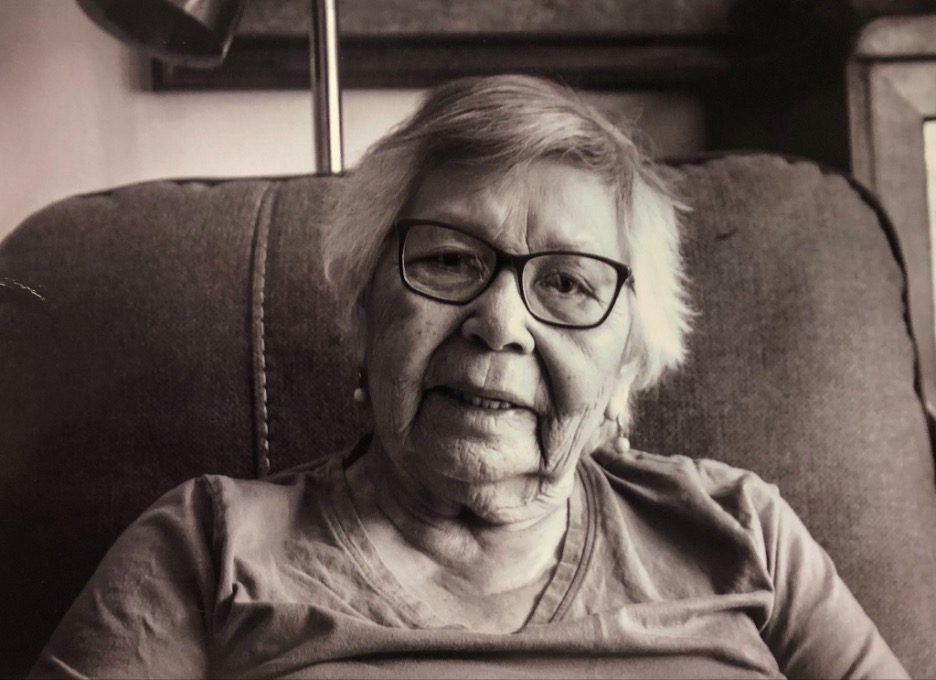
This is the first thing I had asked my grandmother (often referred to as “gram” by family members) how to say in the very first recording I made with her on my journey trying to learn Nishnaabemwin (the word for the Ojibwe language where I come from). It’s an artefact from the beginning of the long road I’ve been on in working to learn and reclaim the language. I am Nishnaabe (also: Anishinaabe, Ojibwe) on my dad’s side and Eurocanadian settler on my mom’s side, and I was raised in my home community where intergenerational transmission of the language has been effectively halted by efforts of colonial powers to eradicate Native languages and cultures. I didn’t speak Nishnaabemwin growing up, outside of a small vocabulary of nouns and verbs, and a few rote phrases. Thankfully, my fluent-speaking paternal grandmother came to be one of my first, and remains one of the most important, language consultants.
I started my Ph.D. in Linguistics at the University of Minnesota (UMN) in the fall of 2018. I had been apprehensive about the prospect of moving away from home for grad school, mostly for the fact that I felt that as long as gram was still around, I needed to commit myself and my time to staying home and working on language with her. When she passed in February of 2018, a week shy of her 87th birthday on Valentine’s day, it was a great loss for the family and community, and a tremendous loss for our language. The decision of whether to stay home or to move away was effectively made for me then.

The move to Minneapolis was exciting. For the previous six years, I had been living back home on the rez,[1] which is bordered by a rural Ontario town of approximately 7,000 inhabitants. The change was welcome, due in no small part to escaping some of what comes with living in a rural environment. These can be trivial things like a lack of good food options in the vicinity outside of chains and fast food, to the more problematic ones like being followed in stores and other such acts of everyday racism. But moving to a larger city in the US midwest, I also ran into some unexpected culture shock. I’d lived in a few cities of varying sizes before, less ethnoculturally diverse than Minneapolis, but the degree of racial segregation present in Minneapolis surprised me. Living close to the University, it was surprising to me to find myself in stores, establishments, and neighborhoods where I was one of very few, and sometimes the only person of color present. There were also numerous reminders of the fact that I was attending an institution where the vast majority of students are White and at a “land grant” university, built upon stolen Dakóta land.[2], [3] Among the new and unfamiliar realms I had to adjust to was that of the academic discipline of Linguistics.
The degree of racial segregation present in Minneapolis surprised me. Living close to the University, it was surprising to me to find myself in stores, establishments, and neighborhoods where I was one of very few, and sometimes the only person of color present.

Legacies of US Extraction in Native American Cultures: Encountering Racism in US Academia and the Discipline of Linguistics
On my very first day as a student of linguistics, I came across a pamphlet by the Linguistic Society of America (LSA) called, “What is an endangered language?” This was relevant to my interests, so I read it, but found a few framings about it troubling–such as one section heading titled, “What does language extinction mean for a community–and for the rest of us?” (emphasis added). It is significant that the vast majority of peoples facing language loss today are Indigenous, and as I am from a community facing such loss; the pamphlet implied that I was not one of the “rest of us” in the community of linguists. The exclusion of Indigenous peoples was not done intentionally, of course, but it speaks to the hegemonic Whiteness of the discipline. The issue of race in Linguistics long preceded me, but important discussions of it were already well underway. In 2018, Charity Hudley et al. published “Linguistics and Race: An Interdisciplinary Approach Towards an LSA Statement on Race,” which observed among many other things,[4] that “as a predominantly White discipline rooted in a liberal, Boasian rejection of scientific racism, linguistics struggles to confront its role in reproducing racism” (2018, 6). My jarring welcome to Linguistics via the LSA pamphlet is unsurprising given that context.
Language loss is inherently the loss of family, culture, and real human beings.
That tone-deaf stance did not surprise me considering Linguistics’ extractivist history with Indigenous peoples. A month or two into my studies, I read a sidebar in a phonology textbook talking about how a group of linguists had found that Yowlumne, a language previously thought “extinct,”[5] still had surviving speakers. The text exclaimed that “We nearly missed it!,” celebrating the fact that the language could still be studied for the benefit of the discipline of Linguistics (Zsiga 2013, 242). Just like how the LSA pamphlet assumed no linguist could be from an Indigenous community, this textbook completely disregarded consideration of people who are actively experiencing language loss. Language loss is inherently the loss of family, culture, and real human beings, and in my lifetime I have witnessed the passing of many language speakers, to the point where there are only a handful left in my community. Having lost my grandmother only months earlier, the casual disregard for the real-life process of language loss felt like an insult.
Examining historical sources is an inherent part of my research and this too isn’t without issues tied to legacies of racism. Many early linguists studying Indigenous languages were missionaries whose motivations for doing so were strictly for religious conversion, a fact stated outright by the Catholic Bishop Frederic Baraga in the foreword of his grammar of Ojibwe (Baraga 1878, vii) and who missioned in Ojibwe country in the 1800s. The mission to convert a people’s spiritual beliefs is rooted in assumptions of both the superiority of one’s own religion and complementarily another’s inferiority. Assumptions of racial and cultural superiority are also seen in the use of terms such as “ignorant,” “barbarous,” and “mentally undeveloped” describing my people, as well as in deeming our language “deficient.”[6] While I can get behind the term “barbarous” in a rejection of Eurocentric views of what constitutes “civilized,” the latter is demeaning, denigrating, and dangerous, especially in an era where such views were instrumental in promoting eugenics and genocide.[7]
Linguistics sidesteps the issue of race and the field has dodged a reckoning, unlike other disciplines such as Archaeology and Anthropology that have been forced to address their inhumane treatment of Indigenous peoples.[8] The legacy of Linguistics is built upon the exploitation of Native peoples and their languages, for in an era of the belief of the “disappearing Indian,” a program of salvage linguistics was undertaken to document Native languages not for the benefit of the people, but for the furtherance of the field. Discussion of this and the issue of race is relegated to the subfield of sociolinguistics and otherwise sidestepped, despite the fact that an overwhelming number of legacy sources on Indigenous languages were begotten unethically in an extractive manner and by individuals whose motivation for learning the language(s) was a means to extinguish Indigenous culture.[9] Engaging in unethical and exploitative research practices in regards to Indigenous peoples is endemic in academia and not at all a thing of the past.[10] Those legacies continue to this day and while discussions of ethics in Linguistics are present, those themselves are often Eurocentric and speak of an “obligation” to the discipline, albeit alongside a mention of how Linguistics can be of help to Native people, itself a view often rooted in White saviorism.
The legacy of Linguistics is built upon the exploitation of Native peoples and their languages… not for the benefit of the people, but for the furtherance of the field
It is this one-sided practice of extractivism combined with an assumption of superiority that is at diametrical odds with and comes into conflict with Indigenous ways of knowing. Reciprocity and relationality is at the heart of Indigenous philosophies and is absent from the Western approach, not at all considered in theory and certainly not in practice.[11] I found myself taking a sidetrack from my studies to write about the issue of racism and the problematic history of Linguistics. Outside of the legacy of treating Indigenous peoples as objects of study to to be exploited for their linguistic resources, there is the fact that the discipline itself ignores and does not address these issues, topics discussed in Charity Hudley et al. (2018, 2020), Gaby and Woods (2020), Leonard (2020), and Rice (2022, 2024).

Navigating Racialized Violence Outside of Academia
In the fall of 2022 in the town next to my home reserve in Canada (I had been dividing my time between the reserve and Minneapolis throughout grad school) I was handcuffed and searched by a police officer in a coffee shop where I’d been working (on a dissertation research funding application) on a Saturday afternoon. I allegedly fit the description of a car theft suspect (that description who as I was told, was a male in his 40s with black hair; I have brown hair, and was forcibly detained despite explaining to the officer the reason for my presence at the coffee shop. In the midst of being detained I made a conscious choice to comply rather than resist. The act of compliance has been ingrained in me from a young age. Being visibly Indigenous, I’ve been subject to questioning and searching by police who made clear the potential consequences of noncompliance. More so, however, I chose not to resist because it was obvious that the officer was making a mistake and that I would be exonerated. It was obvious to me, although no bystanders did anything as I asked for someone to record the incident as I was being handcuffed. I was released when my story checked out via the officer calling in the license plate of my car in the parking lot.
The process of dealing with and moving on from that incident was delayed and drawn out by my now regrettable decision to engage in their system to file a complaint. I naively thought that the wrong would be righted, but unsurprisingly there was found to be no wrongdoing on the part of the officer either in detaining me, or in his neglect to even report that he’d handcuffed and searched me.
I bring up this incident as it is directly relevant to the story of my time in grad school. Not only was I working on grad school work at the very time of the incident but it also severely impacted my ability to complete my studies. I was practically nonfunctional for weeks following the incident, being overwhelmed by frustration, anger, and confusion, and these emotions still plague me due to the lack of a resolution and irresolvable sense of injustice. My degree progress was set back many months because of this experience. For many BIPOC folks, such incidents and the fallout from them are simply a reality of living in a White supremacist society. Such a society forces non-White people to assimilate or capitulate, one consequence being that Ojibwe is now an “endangered” language.[12] This was not always the case, however, with Ojibwe being a lingua franca in the fur trade era for one thing, and another that missionary linguists understood the necessity of learning the language (although they did so with an assimilationist agenda). This was the case in my very own community, a fact relayed by my gram in one of our language sessions where all types of knowledge were transmitted, not just linguistic.
Listen: mekdekonyeg
In a twist of irony, my Anishinaabe grandmother was herself a Christian and a United Church minister, and while I can’t speak for her own beliefs, many people in my community and nation historically had no qualms with incorporating foreign elements into their belief systems.[13]
Respecting Difference: How Indigenous Ways of Knowing are Conceptualized Differently from Western Epistemologies
There is a disconnect between Indigenous ways of knowing and the Western tradition of Linguistics. The disconnect stems at a base level, from conceptions of human language that differ greatly, and at times diametrically between the European and Euroamerican traditions and those of Indigenous nations. For Anishinaabe people, our language is a sacred gift that was given to us by the great spirit and must be treated with the appropriate respect and reverence. Part of this can include not breaking it down and analyzing it as an object of study, and for some this even includes a prohibition of writing the language, at least in a colonial orthography.[14]
There is a verbal suffix in Ojibwe that attaches to the end of words, known in the literature as the dubitative mode, that speakers use when they can’t vouch for the information being conveyed; whether they are uncertain or perhaps making an inference. There are also words in themselves such as iidog that are used for the same reasons.[15] Relatedly, there is a specific word giiwenh, used when someone is relaying secondhand information. The following audio is a short clip from a story told by my auntie Audrey,[16] my gram’s younger sister who by Nishnaabe culture is also my grandmother, a fact reflected in the language as both relate to me as nookmis, “my grandmother.”
Listen: giiwenh and gwen
You can hear the word giiwenh a number of times in the clip and might also pick out -gwen on the end of a word, which is a form of the dubitative mode mentioned above. Speakers use this verb form and related words prolifically when telling stories of happenings they were not present for, as the story the above clip is from, had been passed down by her parents.
This phenomenon of having a system of marking one’s information source in a language is called evidentiality, and the linguistic study of these, at least by Europeans, is relatively new since evidential systems are lacking in languages in their traditions (Aikhenvald 2018, 34). Early European linguists struggled to categorize evidentiality in Indigenous American languages and their attempts provided opportunities to reveal their prejudices held against Native peoples. Baraga’s description of the dubitative mode in Ojibwe attributes it to the fact that “the habit of lying is a strong trait in the Indian character” (1878, 95) and thus speakers need a way to hedge their statements in case they were provided with inaccurate information by way of lies. In addition to being a ridiculous contention, the view is predicated on the racist belief in a moral deficiency of Indigenous people who are considered inherently liars and mistrustful of one another. In reality, it is an indication of how careful Ojibwe speakers are to indicate the sources of their information; it is ingrained in their language and culture.[17]

It is perhaps telling that my grandma initially translated my query referenced at the beginning of this article as “gaa ngiikendziin,” “I don’t know,” and then corrected it to “gaa nnisdotnziin,” “I don’t understand,” as these words carry a bit of a different nuance than their closest English equivalents. The verb stem gikendam is made up of two parts: the first /gik-/ referring to knowing and /-endam/ to perceive, think on, or even feel in one’s mind.[18] Nisidotam, on the other hand, is recognizing by hearing, with the first part /nisidaw-/ denoting recognizing, and the /-t[am]/ component referring to hearing something. Thus the English phrase ‘I don’t understand’ can imply a thought process that is perhaps better captured by ‘gaa ngiikendziin’, whereas ‘gaa nnisdotnziin’ is a more straightforward statement of simply not recognizing something that one heard.
It is perhaps telling that my grandma initially translated my query… as “I don’t know,” and then corrected it to “I don’t understand.”
In a similar way to how Anishinaabeg are reluctant to speak with certainty on a matter there is also a tendency to refrain from telling someone what to do or believe. As systems of evidentials are seen to lend to social cohesion in the cultures of peoples whose languages make them explicit,[19] so too do cultural norms to not impose will or belief upon another. This is witnessed in cultural teachings and rather than ten commandments, Ojibwe culture has (often entertaining) stories with morals behind them. Likewise my gram and auntie (or dad or other Nishnaabe family members for that matter) never told me how to behave or prescribed a way of being, but did often talk about the way things were in the past when people lived with traditional values and lifestyles.
Rather than ten commandments, Ojibwe culture has stories—with laughter, lessons, and relationships at their core.
Listen: medicine and helping others
My auntie also often lamented the fact that very few people spoke our language anymore, not only for the fact that she had very few people to speak it to, but also because conversation in the language is famously humorous.
Listen: old folks and language
It’s a well-known and oft-cited fact among speakers and learners of Indigenous languages, not just my own, that things are “funnier in the language.” It can’t be known for sure but I suspect that the verb-heavy and very descriptive nature of these verbs and the language itself is what makes things so funny. Speakers paint very rich pictures with their words and describing a humorous incident plays a slapstick comedy in the mind of the listener. We Native people often retain the propensity for laughter and joy in our conversation and social interaction even in a colonial language (get any Natives together and they’ll laugh and joke nonstop), but the fact remains that “it’s just funnier in the language.” I can look at the language analytically and note that ‘baapi’ (s/he laughs) is a verb stem that can take many forms depending on who is laughing and if they are laughing at something or someone (including oneself or selves), and further that /-aapi/ is a highly productive verb final that allows for the creation of countless verbs describing ways in which laughter is happening. I can speculate all day but there is great value in understanding something within its own context rather than trying to use European linguistics to reflexively understand a language and cultural context that it is foreign to. We can say that it’s just funnier in the language and leave it at that.
In closing
The support of faculty, namely my advisor Dr. Claire Halpert, was instrumental in helping me to navigate academia and the long road of my graduate studies at UMN. The Institute of Linguistics (IoL) under her guidance put together a page for Indigenous students of Linguistics that was written in large part by students. This is one small example of how academia can take relational accountability[20] by recognizing and respecting the needs of students upon whose lands the University resides (by way of appropriation) and whose people (and in the case of Linguistics, languages) have been exploited for the sole benefit of academia and the dominant Euroamerican society.
In 2022, the Australian Journal of Rural Health, Canadian Journal of Rural Medicine, and Rural and Remote Health created a statement on research and reconciliation with Indigenous peoples. The journals commit to signifying which contributing authors are Indigenous, and also to reject papers “that concern Indigenous communities but do not acknowledge an Indigenous author or provide evidence of a participatory process of Indigenous community engagement” (Lock et al. 2022, 1). This is an appropriate action considering that Indigenous ways of knowing have historically been and continue to be ignored in researchers’ dealings with Native people. Tuck and Yang (2012) among many others, point out that decolonization is a discomforting process and if the prospect that one’s own work (let alone that of their discipline) doesn’t hold up to the level of scrutiny put forth by the health journals above then maybe you’re on the right track.
Indigenous ways of knowing are ignored and outright denied in academia and the dominant society, and our experiences are relegated to sidelines or silenced, like how discussions of social justice in Linguistics are relegated to sociolinguistics. Telling my own personal story was my motivation for writing this article. I have discussed many of these issues to a degree in papers I’ve written and have had published, and while I sought to infuse those with my stories and experiences, I could only do so to a certain extent. I couldn’t use the F word in those papers. I couldn’t talk about how the experiences made me feel. I couldn’t talk about how being subject to racism and police violence permeates my experience in all facets of life. But all these things are an inherent part of being me in a colonial society, and this was a bit of an excerpt of that in how I experienced grad school.
Mii iw. That’s it.
References
Aikhenvald, Alexandra Y. 2018. “Evidentiality: The Framework.” In The Oxford Handbook of Evidentiality, edited by Alexandra Y. Aikhenvald, 1st ed., 1–44. Oxford University Press. https://doi.org/10.1093/oxfordhb/9780198759515.013.1.
Baraga, Frederic. 1878. A Theoretical and Practical Grammar of the Otchipwe Language for the Use of Missionaries and Other Persons Living Among the Indians, second edition. Montreal: Beauchemin & Valois.
Charity Hudley, Anne H., Christine Mallinson, and Mary Bucholtz. 2020. “Toward Racial Justice in Linguistics: Interdisciplinary Insights into Theorizing Race in the Discipline and Diversifying the Profession.” Language 96 (4): e200–235. https://doi.org/10.1353/lan.2020.0074.
Charity Hudley, Anne H., Christine Mallinson, Mary Bucholtz, Nelson Flores, Nicole Holliday, Elaine Chun, and Arthur Spears. 2018. “Linguistics and Race: An Interdisciplinary Approach towards an LSA Statement on Race.” Proceedings of the Linguistic Society of America 3 (1): 8. https://doi.org/10.3765/plsa.v3i1.4303.
Davis, Jenny L. 2017. Resisting rhetorics of language endangerment: Reclamation through Indigenous language survivance. In Wesley Y. Leonard & Haley De Korne (eds.), Language documentation and description (14). 37–58. London: EL Publishing.
Gaby, Alice, and Lesley Woods. 2020. “Toward Linguistic Justice for Indigenous People: A Response to Charity Hudley, Mallinson, and Bucholtz.” Language 96 (4): e268–80. https://doi.org/10.1353/lan.2020.0078.
Harvey, Sean P. 2015. Native Tongues. Cambridge, MA: Harvard University Press.
Koennecke, Franz M. 1986. Wasoksing: The history of Parry Island, an Anishnabwe community in the Georgina Bay, 1850 to 1920. MA thesis (University of Waterloo, 1984) 26.
Leonard, Wesley Y. 2020. “Insights from Native American Studies for Theorizing Race and Racism in Linguistics (Response to Charity Hudley, Mallinson, and Bucholtz).” Language 96 (4): e281–91. https://doi.org/10.1353/lan.2020.0079.
Leonard, Wesley Y. 2021. “Toward an anti-racist linguistic anthropology: An Indigenous response to white supremacy.” Journal of Linguistic Anthropology 31(2), 218-237. https://doi.org/10.1111/jola.12319.
Lock, Mark, Faye McMillan, Bindi Bennett, Jodie Lea Martire, Donald Warne, Jacquie Kidd, Naomi Williams, Paul Worley, Peter Hutten-Czapski & Russell Roberts. 2022. “Position statement: Research and reconciliation with Indigenous peoples in rural health journals.” Australian Journal of Rural Health 27(1). 1–2. https://doi.org/10.1111/ajr.12834.
Ojibwe People’s Dictionary. 2024. Department of American Indian Studies. University of Minnesota. http://ojibwe.lib.umn.edu.
Reardon, Jenny, and Kim TallBear. 2012. “‘Your DNA Is Our History’: Genomics, Anthropology, and the Construction of Whiteness as Property.” Current Anthropology 53 (S5): S233–45. https://doi.org/10.1086/662629.
Rice, Mskwaankwad. 2024. “”Reflections of a “Barbarous, Mentally Undeveloped” Linguist: On the Legacy and Obligations of Algonquian Studies and Linguistics.” In Papers of the Fifty-Third Algonquian Conference/Actes du cinquante-troisième Congrès des Algonquinistes. Noodin, M., Macaulay, M., & Genee, I., eds.
Rice, Mskwaankwad. 2022. “Power and positionality: A case study of linguistics’ relationship to Indigenous peoples.” Proceedings of the Linguistic Society of America, 7(1), 5295. https://doi.org/10.3765/plsa.v7i1.5295.
Truth and Reconciliation Commission of Canada. 2015. Honouring the truth, reconciling for the future: Summary of the final report of the Truth and Reconciliation Commission of Canada. Winnipeg: Truth and Reconciliation Commission of Canada.
Verwyst, Chrysostom. 1900. Life and Labors of Rt. Rev. Frederic Baraga, First Bishop of Marquette, Mich. Milwaukee, WI: M.H. Wiltzius.
Wilson, Rev. Edward F. 1874. The Ojebway Language: A Manual for Missionaries and Others Employed among the Ojebway Indians. Toronto: Rowsell and Hutchison.
Woodbury, Anthony C. n.d. Betty Birner (ed). What Is an Endangered Language? Linguistic Society of America Pamphlet. https://www.linguisticsociety.org/resource/faq-whatendangered-language.
Audio and Visual References
Audio file name: I don’t understand
- Interviewee: Aileen Rice
- Date: 2010
- Location: Wasauksing First Nation
- Type of interview: informal linguistic, unpublished
- Interviewer: Mskwaankwad Rice
Audio file name: old folks and language
- Interviewee: Audrey Pawis
- Date: April 26, 2020
- Location: Wasauksing First Nation
- Type of interview: informal linguistic, unpublished
- Interviewer: Mskwaankwad Rice
Audio file name: medicine and helping others
- Interviewee: Audrey Pawis
- Date: December 24, 2019
- Location: Wasauksing First Nation
- Type of interview: informal linguistic, unpublished
- Interviewer: Mskwaankwad Rice
Audio file name: mekdekonyeg
- Interviewee: Aileen Rice
- Date: November 30, 2017
- Location: Wasauksing First Nation
- Type of interview: informal linguistic, unpublished
- Interviewer: Mskwaankwad Rice
Audio file name: giiwenh and gwen
- Interviewee: Audrey Pawis
- Date: December 29, 2021
- Location: Wasauksing First Nation
- Type of interview: informal linguistic, unpublished
- Interviewer: Mskwaankwad Rice
Footnotes
[1] Slang term for Indian reservation (US) or reserve (Canada).
[2] See the findings of the TRUTH project for details.
[3] However, this is not suprising but it is here where I learned about Redlining.
[4] Numerous other important issues are discussed in the article, such as the colonial legacy of the field, the overresearching of racialized groups, and racial erasure and displacement, to name a few.
[5] Terms such as these are problematic as they imply that language loss is a natural process (see Davis (2017)).
[6] Verwyst (1900:2), (Wilson 1874:iv).
[7] Harvey (2015) explains how concepts of language and race were used to justify colonial efforts to eradicate Native peoples and cultures.
[8] See Charity Hudley et al. (2018, 2020), Gaby and Woods (2020), Leonard (2020), and Rice (2022, 2024) for discussion.
[9] The summary of the final report of the Truth and Reconciliation Commission of Canada (2015:48) comments on the role of missionaries in this regard.
[10] Reardon and TallBear (2012) discuss a case in which Arizona State University (ASU) misused blood samples from Havasupai people without informed consent and moreover asserted their right to do so for scientific merit. The authors write: “What is notable for our analysis is not that population geneticists distributed Havasupai DNA to non-ASU researchers without informed consent but that once this was pointed out, researchers still adamantly defended their right to engage in this practice.”
[11] Leonard (2021) cites R’s discussed in literature on ethical research, “[e]mploying ideas from Indigenous research methodologies such as the notion of relational accountability and related “R’s” such as respect, responsibility, reciprocity, and rights.”
[12] Again, such terms can imply that language loss is a natural process. The process of the “loss” of language occurs with the deaths of people who speak it, but Ojibwe exists and will continue to exist whether it is spoken or not.
[13] Koennecke (1984).
[14] These facts have been relayed in personal conversation with Elders.
[15] Iidog and its variants can be translated as: maybe; must be; evidently; apparently, might be; supposedly, etc.
[16] Auntie Audrey was my gram’s last surviving sibling who became my go-to language consultant until her own passing in 2024.
[17] As a learner of Ojibwe and L1 speaker of English, I myself have encountered the linguistic disconnect between languages that possess and lack evidential systems. I was sitting with a teacher/Ojibwe language speaker at a dinner one time when watched a server walk by with a cheesecake. I asked my teacher how I would say “that looks good” in Ojibwe and she replied, “mnopgozdog”, which is an evidential construction essentially meaning, “that must taste good.” This is not at all a literal translation of the English and actually a better description of what was being implied by my English statement.
[18] Word parts and glosses are taken largely from the Ojibwe People’s Dictionary.
[19] Aikhenvald notes the importance of evidentiality for social cohesion (2018, 28-29).
[20] See Leonard (2021) for an explanation of this concept in relation to Indigenous peoples.