
I finished the first year of my doctoral program in counseling psychology in early May of 2020. About two weeks later, George Floyd was murdered. As a Black woman living in Minneapolis at the time of this unrest, I was processing both the all-too-familiar trauma of yet another police killing going viral and the new trauma of living in the epicenter of the largest racial reckoning within my lifetime. Despite my fear, anger, and sadness, I spent the month of June using social media to raise over $20,0001 to buy supplies for different organizations within the Twin Cities. During this time, I worked alongside many brave activists, organizers, and volunteers who were also caring for the community amid what felt like a hopeless situation.
I was processing with my dad towards the end of my supply runs, telling him that I felt that I was “just plugging holes in a ship that was doomed to sink.” In the kindest words possible, my dad told me that I was right, pointing out that I was no longer just bringing supplies to people who had lost access to local grocery stores or pharmacies due to the violence; I was also providing supplies to areas and people who probably had struggled to get these resources long before the unrest. The realization that I, as one twenty-something year old graduate student, could only do so much in the face of vast structural and systemic failures, relieved a lot of guilt at what I perceived to be my uselessness. It also gave me a sense of clarity, purpose, and drive in beginning the second year of my doctoral program and a blueprint for the kind of psychologist I aim to be.
The interventions I can provide my clients to alleviate distress can only do so much if they are still struggling to make ends meet and find affordable childcare.
As a counseling psychologist, I am trained in clinical work and research and tend to focus on individual level issues and solutions. In the therapy realm, this may look like conceptualizing a client’s distress through individual (e.g., unhelpful thinking styles) or interpersonal (e.g., early maladaptive relationship patterns) factors (Corey, 2013). Within research this can look like focusing on aspects of an individual’s identity, personality traits, or behaviors they engage in as a possible explanation for well-being outcomes. This approach often does not acknowledge the extent to which social conditions impact one’s functioning and well-being. As the daughter of Nigerian immigrants who was born and raised in America, I am acutely aware of the ways in which factors such as racism, sexism, classism, and many other “-isms” impacts me and my loved ones’ daily lives, which in turn affects our well-being. The interventions I can provide my clients to alleviate distress can only do so much if they are still struggling to make ends meet and find affordable childcare. Research that examines how marginalized students with more “grit2” have better school outcomes is meaningful, but can feel hollow in the context of the school-to-prison pipeline. In other words, I often feel that in our focus on individual factors we lose sight of the broader societal issues that create the conditions we are trying to ameliorate on the individual level.
Through my coursework and clinical experiences I discovered a feminist theoretical orientation. A theoretical orientation is the framework that psychologists use to conceptualize the past and current thoughts, behaviors, and experiences that contribute to their client’s dysfunction. Feminist therapy places pathology within systems of oppression rather than the individual and conceptualizes the distress that an individual experiences as a reaction to societal ills. It emphasizes the importance of recognizing “the impact of society in creating and maintaining the problems and issues brought into therapy” (Feminist Therapy Institute, 1999, p.1), and a commitment to “reducing the pervasive influences and insidious effects of oppressive societal attitudes” ( p.1). This commitment towards activism and advocacy is logical. If I am aware that the things causing distress for my clients are these larger issues outside of the therapy room, there is only so much I can do within the therapy room. I have to attack the problem at the root3.
It was one thing to believe these ideas on a theoretical level, but my experience on the ground in occupied Minneapolis solidified my understanding and commitment to living out these values. I had intimately experienced the emotional toll of throwing my everything at the problem directly in front of me and seeing little-to-no change. I had sat with the helplessness of realizing that my mutual aid efforts were little more than a stopgap. In saying this, I’m not discounting the tangible help the supplies I bought had for the families who received them. I know it had an impact, but in my helping of people at the individual level, I was frustrated that these gaps were even allowed to exist at the structural level.
I turned to Black feminism to help me alchemize this anger into fuel. In addition to acknowledging the negative impact interlocking systems of oppression have on those who live in the margins, it places importance on individual lived experiences and how they speak to broader structural and historical patterns (Collins, 2022). Further, its focus on giving voice to marginalized voices, centering community and care, and understanding that seeking freedom for the most vulnerable will benefit everyone resonated deeply with me. Engaging with the work of brilliant scholars, writers, artists, and activists passionate about dreaming and working towards a better world nourished me. In particular, bell hooks’ (2001) writings on love helped me reframe my belief that activism is fueled by anger at injustices to viewing it as an act of love and community care. I began to feel I was part of an inter-generational community working towards a better world. Through Black feminism, community and love became the roots that nurtured me as I navigated graduate school.
So what does this mean for me as a Black feminist psychologist committed to providing care and conducting meaningful research? As a clinician, I often mentally categorize my clients as those who come in looking for skills for survival versus those who have the luxury to focus on thriving. I want to create a world in which all my clients enter therapy with the luxury to grow in whatever ways they wish rather than focusing their energy on navigating the emotional toll of navigating racist, sexist, and capitalist systems. I know the space I provide to process difficult events and skills I teach to regulate emotions have a meaningful and lasting impact on my clients’ lives. And I so desperately want to soften the conditions of the world so there is less trauma for them to recover from. Therapy, as with anything related to health, is political. And if I understand that therapy is inherently political, then it follows that I view my duty as deeply connected to my activism and advocacy efforts beyond the therapy room.
I want to create a world in which all my clients enter therapy with the luxury to grow in whatever ways they wish rather than focusing their energy on navigating the emotional toll of navigating racist, sexist, and capitalist systems.
As a researcher, I’ve drawn from my own experiences and sought to center voices and experiences from my communities that were not represented within the literature. For example, since my own experience I have begun a line of research that examines the role that activism plays in maintaining one’s well-being during traumatic times, such as during the racial unrest in Minneapolis. For my dissertation, I am exploring whether Black women’s understanding of the Strong Black Woman4 schema and its relationship to psychological outcomes differs among Black women from different ethnic backgrounds. I also believe that it is my duty to see that the impact of my research extends beyond a publication. What would it look like to use my research on activism as the basis for developing an activist-based therapy intervention? My dissertation explicitly names the roles that racism, sexism, and misogynoir5 have played in the development and maintenance of this cultural ideal rather than approaching it as a “trait” that emerged out of thin air. In directly naming the broader, cultural condition I highlight the necessity of combatting them.
Overall, I see my duty as a psychologist falling into three areas: 1) directly calling out and combating harmful systems as an activist and advocate; 2) creating knowledge through research that provides a concrete understanding of the harms these systems cause; 3) providing care for individuals and communities who are hurt by these systems.
This work is both meaningful and draining, as is any commitment to advancing social justice. However, feeling grounded in my purpose–a purpose shaped by Black feminism, and professional and personal experiences–provides me with a well of strength to draw from when I feel myself becoming exhausted. Understanding my work as a part of something greater than myself and immediate graduate school stressors, truly does provide comfort. Finding community among other Black feminists who are committed to caring for each other while working towards a better world has been my lifeline during the most difficult and hopeless moments. Rooting my work in love instead of anger fills rather than drains me. Since June 2020, there have been many times in my graduate school journey when the weight of all I hope to achieve, alongside the mountains I have to climb, has felt overwhelming. But the knowledge that I am not the only one trying to plug up the holes, that there are people alongside me, makes that future seem more attainable.
References
Collins, P. H. (2022). Black feminist thought: Knowledge, consciousness, and the politics of empowerment. Routledge.
Corey, G. (2013). Theory and practice of counseling and psychotherapy (9th ed., Student ed.). Brooks/Cole / Cengage Learning.
Feminist Therapy Institute. (1999). Feminist Therapy Institute Code of Ethics. (1990, Revised 1999).
hooks, bell. (2001). All about love : New visions (1st Perennial ed.). Perennial.
Scenes from the Minneapolis Uprising
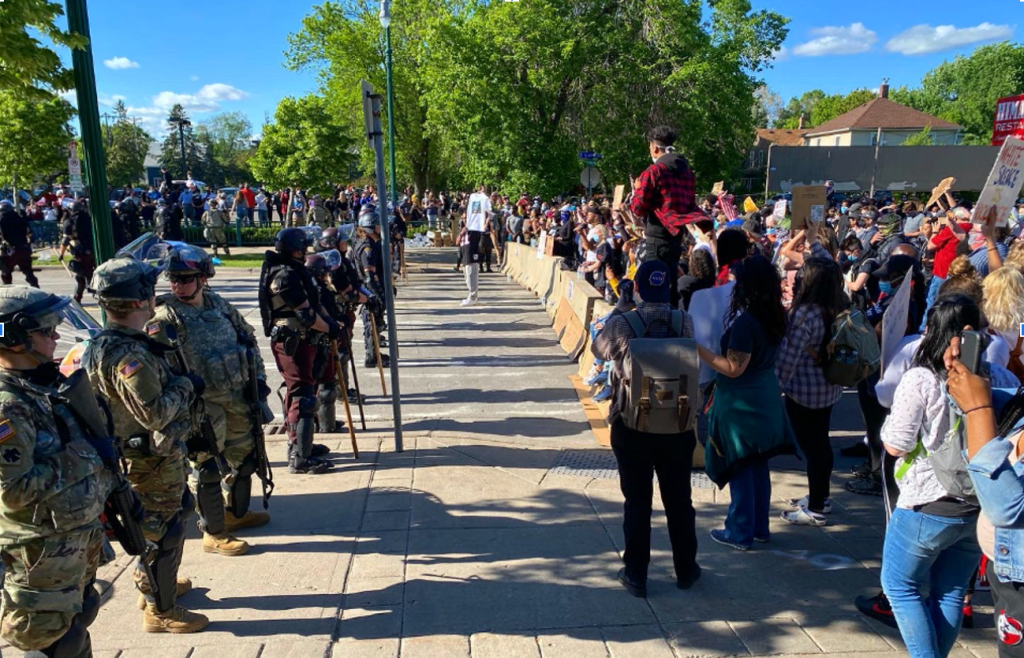
In addition to spending my time running supplies and volunteering, I thought it was an important part of my duties during June 2020 to document everything that I witnessed. Below are just a few of the photos I took during that time. I included photos that document the destruction and militarized police presence, which are images that usually come to mind when we think of this time. However, I also want to show images of the ways that the community showed up for each other. People donated hundreds of thousands of dollars worth of supplies to organizations throughout the Twin Cities and volunteered their time to make sure those in need got what they needed. It is important to me that these images, as well as the art that popped up around the city, are also widely seen.
Endnotes
- To read more about this endeavor, please see this Star Tribune article: https://www.startribune.com/i-m-in-danger-just-living-in-america-for-black-community-floyd-s-death-brings-more-grief-and-trauma/571242852/
↩︎ - Within psychology, grit refers to a “personality trait characterized by passion and perseverance for attaining long term goals” https://dictionary.apa.org/grit ↩︎
- I do want to clarify that I do believe, and work with people who are dealing with distress that isn’t directly related to societal issues. I believe that even if we lived in a perfect world, there would be people still struggling with depression, anxiety, and serious mental illnesses. However, I do often see clients whose distress is either directly caused by social issues, or is exacerbated by discrimination, money, or legal issues. ↩︎
- Refers to the beliefs and cultural expectations of resilience, independence, strength, and caretaking that shape Black womanhood. ↩︎
- A term coined by Dr. Moya Bailey to describe the unique form of “anti-Black racist misogyny” that Black women experience. ↩︎