
The painting below emerged from an eight-week educational cohort on body healing that centered around social justice themes and was influenced by Traditional Chinese Medicine (TCM) and Somatic Experiencing (SE). Somatic abolitionism (Menakem, 2022) served as the theoretical framework for this cohort; somatic abolitionism asserts that healing racialized traumas and striving for abolitionism—a movement dedicated to dismantling systemic oppression, especially the school-to-prison pipeline—requires each individual to engage in processing these micro-moments in their bodies and acquiring healing tools. Each weekly session spanned approximately 2 hours to 2.5 hours, creating a sustained and immersive experience.
The cohort was led by one SE and one TCM-trained facilitator, Aziza and Joi, respectively, each of whom had worked on racialized healing in their practice for many years. It was a radical dreaming space. The two facilitators came up with the term Adoptive Responsive Relationship (ARR) as the overarching theme for participants to think about basic questions, such as: what is the body? And what is the sense of self? They invited all of the participants to both individually and collectively consider the following: what does it mean to heal, without using many words, but staying with our bodies? How can we be present with our emotions stored in our bodies? And what does it mean for the cohort to work collectively in the space in a way that is respectful and safe? As one of the participants, I was fortunate to feel the transformative moments in my body during this journey.
What does it mean to heal, without using many words, but staying with our bodies; how can we be present with our emotions stored in our bodies; and what does it mean for the cohort to work collectively in the space in a way that is respectful and safe?
This Is My Space
At one of the earlier sessions, the cohort builds a space to collectively understand the “self” and others. The facilitators invite us to take a strand of purple yarn and circle it on the ground. When I sit inside of my circle and try it out, I feel like it needs to be bigger. I expand it by a few inches; it feels a bit loose so I shrink it again. I want to make a hexagon and it takes some effort to make it look symmetrical. I manipulate the yarn until it looks just right. I don’t need more space or less. Then, I cut the yarn. This brings a sense of certainty and form.
I feel like my space is made of beeswax; it can be hard when cold, but it can also be soft, thin, and transparent, as it responds to the temperature. I get busy pretending (and genuinely believing) to build a three-dimensional “wall”: front, back, all around. From low to high, I meticulously sculpt my space, even opening a thin window and sealing up the roof. This fills my limbs with creative power, without needing to exert too much effort. I know how to do it on the spot, like in a child’s game.
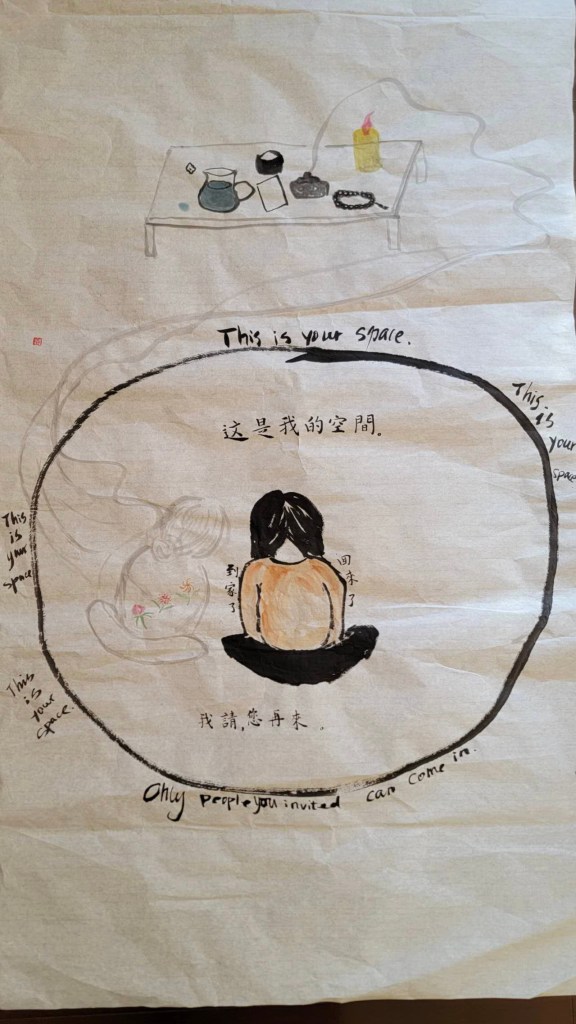
After everyone “builds” their houses, we spend some time thinking about how to say, “This is my space.” 这蒻銌鎏厗间。这蒻銌鎏礜盘。 I try several ways to say, “This is my space,” in Chinese, in English, loudly, softly, and savoring the feelings that different voices bring me. In the end, I speak it out loud between each claim, and then I breathe deeply and fully in the circle. Breathing, I feel my skin slowly tightening. Not overly tight, like wearing ill-fitting pajamas, but the skin gently reminds me, “I am here.” My abdomen rises with a warm feeling. I gently touch my skin, arms, and ankles, feeling the love that contact brings. When I finish speaking, others respond to me, “This is your space.” It seems that those voices just gracefully fall on the boundary I have woven. Their voices, echoing, help me shape the outer wall of the space, and I cast the inner wall myself. But, I don’t feel that my space overlaps with other people’s spaces. I don’t feel threatened. I don’t feel that other people’s spaces are bigger or smaller than mine. I get the space that I need.
If I Invite You, You Can Come
Other participants in the room have different requirements. The bodies, our great bodies, really know what we want. A participant asks, “Can we use the sound ‘u’ — together for me?” Then, a light and distant sound, like a dove’s whistle, rings out in the sky; all of us are echoing together for our friend’s space. It is like a chanted psalm, “You are here, what a wonderful thing!” I play with my own language again, declaring in Chinese, then in English, “Only those I invite can come in.” In the beginning, it has an English structure translated back to Mandarin: 幰膧銌请鎏嬣謢“进来。Then it becomes more of a Mandarin way of speaking: “銌嫄请ㄛ您别来”; “If I didn’t invite you, you don’t come.” Finally, it becomes the way I used to speak, “銌请您謖来”; in English, “If I invited you, you could come.” Speaking the words in Chinese, I feel like I don’t have to try, I already am. My jaw makes a little more space. Claiming these words, I build a space in a way that I’ve known for a long time, it is more real, concrete, and at ease. Saying “銌请您謖来/ If I invited you, you could come,” seems to isolate the noise of the world. This small space is safe, quiet, and warm. Even if it’s just for a moment, I don’t have to be overly alarmed; I don’t have to only respond to the outside world; I don’t have to exert myself. The other participants outside of my circle interacted with my declaration again. Of course, I also believe in and support the space and existence they need in this way.
I Thought I Was Here to Do Research, But I Saw My Grandmother Instead
The wind starts in the yard. The scent of the lit incense drifts away, and the candlelight next to it flickers. I close my eyes and continue to breathe, feeling my grandmother come to my side. I thought I had forgotten her thin and sparse gray hair; forgotten her flat big feet, she was a farmer’s daughter and needed to work so she hadn’t had her feet bound; forgotten the taste of her dentures soaking in a teacup; forgotten her long and thick breasts that had deeply nourished eight children; and also forgotten…her flowers. She started giving birth when she was 16 years old and only knew the three characters in her own name. In her lifetime, my grandmother experienced both war and violence, but she never stopped creating. She would embroider, cut, and paint flowers on gray-blue cotton jackets with patches piled on patches, on the windows, and on mixed flour corn pancakes. She was a short person with sloped shoulders, who did not argue, and was often silent, but she would block the whip Grandpa used to hit my dad with. My grandmother leans against me, gently touching my hair, and then leaves. My eyes are full of tears. I thought I was here to do research, but I saw my grandmother. My grandma brings abundant love. I am not a lone person scattered here.
Just as I’m having a bit of trouble returning to my senses, the facilitator invites us to see the mutual support of the participants around us and once again connect with other participants using eye contact and simple body postures, not language. I only want to send blessings to the other people present, to believe that they also deserve to belong here, feel safe, and be loved. We all look around with gentle eyes and smile without words. 么‘没发蛺过ㄛ幰蒻銌鎏蜰体围騝擩砆椈线。变羛。It is as if nothing had happened, only my body is surrounded by a piece of yarn. But, something has changed.
Throughout these experiences, the cohort has become a means of healing, connecting, and rediscovering oneself. When COVID struck, I felt alienated from this place. I pondered the significance of living in the present moment. In my studies, I’ve struggled to combine my Somatic Experience practice with academic research. Somatic abolitionism, which focuses on an embodied practice, has grounded me and shaped my approach to research. This involves questioning how I understand “land” as a system of mutual social relationships and ethical practices, serving as a basis for decolonial critique (Wildcat etal, 2014). Lowe (2015) points out that colonial discourse portrayed the Chinese as a “free race” distinct from slaves to construct racial hierarchies in the colonies. However, this discourse obscured the fact that it was not only slaves who were deprived of freedom, but also Indigenous peoples and indentured laborers. Lowe emphasizes that colonizers exploited racial differences to divide the exploited groups and consolidate their rule.
When does research, grounded in somatic abolitionism, become healing? I thought I was doing research, yet I saw my grandma. I felt whole and able to rest. I am no longer the individual me anymore. I was not—but I forgot about it. I forgot that I am her dream. From a materialist point of view, it might be just an imagination, with the fact of a person sitting in a circle made of a piece of purple wool. But this visit has changed me; it made space for me to be here wholeheartedly.
References
Lowe, L. (2015). The intimacies of four continents. Duke University Press.
Menakem, R. L. (2022). The quaking of America: An embodied guide to navigating our nation’s upheaval and racial reckoning. Central Recovery Press.
Wildcat, M., McDonald, M., Irlbacher-Fox, S., Coulthard, G. (2014). Learning from the land: Indigenous land based pedagogy and decolonization. Decolonization: Indigeneity, Education & Society, 3(3), I-XV.